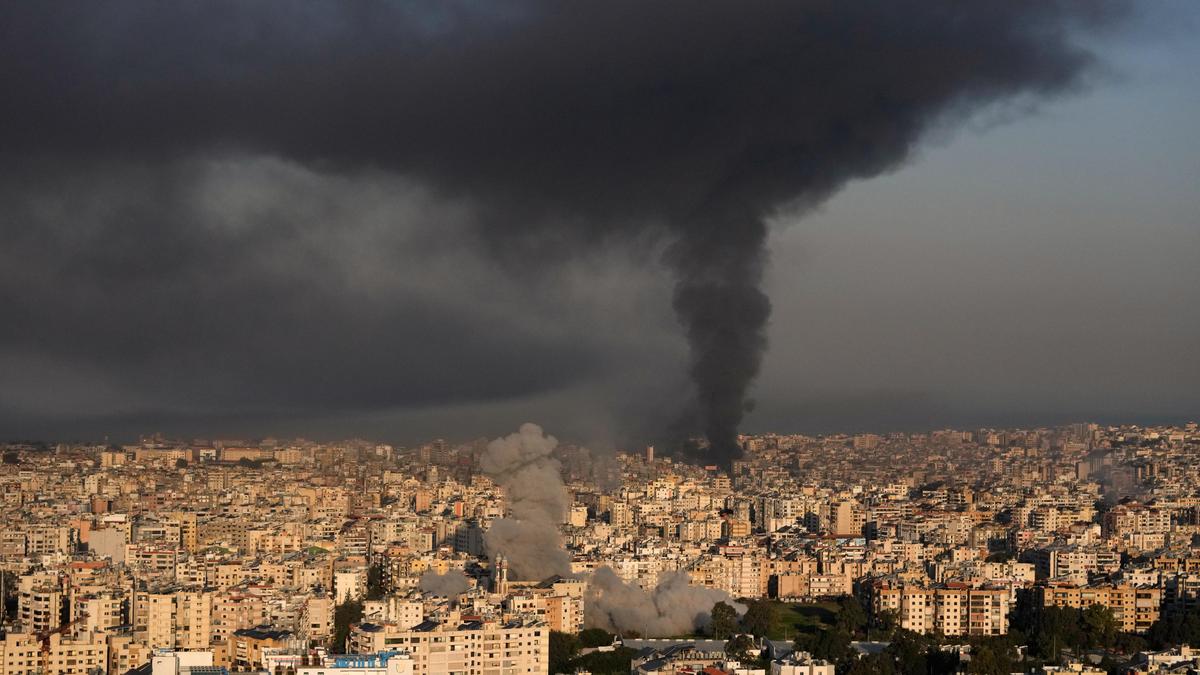
The threshold has been crossed. After a year of calculated exchanges and atmospheric dread, the Israel Defense Forces (IDF) have officially transitioned from defensive containment to active ground operations in southern Lebanon. This is no longer a shadow war of drones and deniable assassinations. It is a direct physical confrontation meant to dismantle the infrastructure of Hezbollah's Radwan Force. The primary objective is the forced removal of militant assets from the immediate border area to allow approximately 60,000 displaced Israeli civilians to return to their homes in the Galilee. While the military describes these as "limited, localized, and targeted raids," the history of Lebanese incursions suggests that the initial footprint rarely dictates the final scale of the conflict.
The Buffer Zone Mirage
Military planners in Tel Aviv are operating under the premise that a surgical removal of tunnels, launch pads, and weapon caches within three kilometers of the Blue Line will neutralize the threat of a cross-border massacre. This is a tactical solution to a strategic nightmare. Hezbollah spent nearly two decades turning the rugged limestone terrain of southern Lebanon into a subterranean fortress. These are not the makeshift tunnels seen in Gaza. These are reinforced, electrified conduits carved into mountain rock, designed to survive heavy bombardment and facilitate rapid ambushes against invading armor.
The "why" behind this specific timing is clear. Israel believes it has decapitated the Lebanese group's leadership, culminating in the strike that killed Hassan Nasrallah. In the eyes of the IDF General Staff, the enemy is currently in a state of command-and-control paralysis. This creates a window of opportunity to clear the border before a new hierarchy can solidify. However, the "how" of this operation remains fraught with risk. Ground troops are entering a kill zone where the defender has the home-field advantage and an arsenal of sophisticated anti-tank guided missiles that can turn a "localized raid" into a static war of attrition.
The Intelligence Trap
There is a dangerous confidence radiating from Israeli intelligence circles right now. After a series of spectacular successes—including the pager explosions and the precision strikes on the Jihad Council—there is a sense that Hezbollah is a spent force. This assessment may be a catastrophic miscalculation. While the centralized leadership has been battered, the local units in villages like Maroun al-Ras and Bint Jbeil operate with significant autonomy. These cells do not need a direct order from Beirut to fire a Kornet missile at a Merkava tank.
History serves as a grim reminder. In 2006, the IDF entered Lebanon with similar goals of pushing Hezbollah back to the Litani River. They found a decentralized enemy that used the terrain to negate Israel’s technological superiority. Today, Hezbollah is better armed, battle-hardened from years of fighting in Syria, and possesses a drone fleet that can bypass traditional air defenses. If the IDF stays too long, they become targets. If they leave too quickly, the vacuum is filled by the very militants they sought to displace.
The Economic and Political Stakes
Inside Israel, the political appetite for a prolonged ground war is high but fragile. Prime Minister Benjamin Netanyahu’s government is under immense pressure to deliver a definitive victory that justifies the cost of a multi-front war. The Israeli economy is bleeding. Reservists have been pulled from their jobs for months on end, the tech sector is shivering, and the credit rating of the state has taken a hit. A quick, decisive victory in the north would restore a sense of security and potentially stabilize the domestic front. A quagmire, however, would be ruinous.
Across the border, Lebanon is a state in name only. Its economy collapsed years ago, its political class is paralyzed, and its national army sits on the sidelines as a non-factor. The Lebanese people, including those who despise Hezbollah, are now watching their sovereignty evaporate. This fuels a cycle of radicalization that ensures the next generation of fighters is being recruited even as the current infrastructure is being demolished.
Tactics Over Strategy
The IDF is currently employing a "Rolling Entry" tactic. Instead of a massive armored thrust aimed at Beirut, they are utilizing specialized commando units supported by massive aerial cover to sanitize specific grid squares.
- Village Clearing Operations: Soldiers move house-to-house to locate shafts leading to the "Conquer the Galilee" tunnel network.
- Artillery Shaping: Sustained fire creates a scorched-earth buffer where movement is visible from the air.
- Electronic Warfare: Total saturation of the frequency spectrum to prevent remote detonation of IEDs.
The problem with this approach is that it assumes the enemy will fight for the dirt. Hezbollah’s doctrine is "dissuasive defense." They let the enemy in, wait for the supply lines to stretch, and then strike the tail. By the time an Israeli platoon realizes they are in a trap, the "localized raid" has become a frantic rescue operation.
The Iranian Variable
Tehran is currently watching its most expensive proxy being dismantled. For decades, Hezbollah was the "insurance policy" for the Iranian nuclear program—a deterrent meant to rain fire on Tel Aviv if Israel ever struck Iran’s centrifuges. If that deterrent is neutralized on the ground in southern Lebanon, Iran faces a binary choice: watch its influence evaporate or intervene directly.
The recent ballistic missile barrages from Iran suggest they are no longer content with strategic patience. However, direct intervention risks a full-scale regional war that could bring the United States into the fray. This leaves Hezbollah to fight a lonely war of survival. They are fighting not just for territory, but for the relevance of the "Axis of Resistance." This desperation makes them more dangerous, not less.
The Logistics of a Buffer Zone
If the IDF succeeds in clearing the first five kilometers of Lebanese territory, the next question is who holds it. Israel has no desire to re-occupy southern Lebanon as it did from 1982 to 2000. That era was defined by a steady stream of body bags and a demoralized public. Yet, if they withdraw, Hezbollah will return. The UN peacekeeping force, UNIFIL, has proven utterly incapable of enforcing Resolution 1701, which was supposed to keep the area free of armed militants.
The only way to avoid a permanent occupation is a diplomatic settlement that has teeth—a scenario that seems impossible in the current climate of mutual elimination.
The Cost of Silence
The international community is largely paralyzed. The United States provides the munitions and the diplomatic cover, while simultaneously calling for de-escalation in a display of geopolitical cognitive dissonance. The Arab world is divided; many Gulf states would love to see Hezbollah weakened but cannot publicly support Israeli military action. This leaves the soldiers on the ground to dictate the future of the Middle East through the sights of their rifles.
As the sun sets over the hills of southern Lebanon, the sounds of outgoing artillery are the only reliable indicators of progress. The maps in the IDF headquarters show red zones turning blue, but maps do not capture the reality of a determined insurgency. The "limited" nature of this operation is a label, not a guarantee. Every meter gained increases the complexity of the exit strategy.
Israel has proven it can strike anywhere in Lebanon with impunity. It has proven it can liquidate its enemies' leadership. Now, it must prove it can manage the chaos it has unleashed. The ground war is no longer a threat; it is a grinding reality that will reshape the border for a generation. The soldiers are in Lebanon, and the path back is significantly more complicated than the path forward.
Check the readiness of your local civil defense and maintain an emergency kit with at least 72 hours of supplies, as the potential for rapid escalation into central Israel remains a statistical certainty.