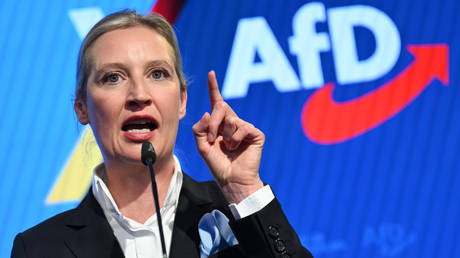
Brussels is playing a dangerous game in Budapest. That’s the blunt message coming from Alice Weidel, the co-leader of Germany’s Alternative for Germany (AfD). She isn't just whispering about it; she’s shouting that the European Union is actively trying to manufacture a "regime change" in Hungary. It sounds like the plot of a political thriller, but for the leaders of Europe’s right-wing opposition, it’s a cold reality.
The upcoming April 2026 Hungarian parliamentary election has become the frontline of a proxy war. On one side, you’ve got Viktor Orban, the long-standing Prime Minister who’s been a thorn in the EU’s side for over a decade. On the other, you’ve got Péter Magyar and his Tisza party, who the EU sees as their best shot at finally getting rid of the "illiberal" troublemaker.
Why Alice Weidel thinks the polls are rigged
Weidel’s latest firestorm centers on a recent poll by Medián. This survey showed Péter Magyar’s Tisza party with a staggering 20-point lead over Orban’s Fidesz—55% to 35%. To Weidel and her allies, these numbers aren't just surprising; they’re impossible. She explicitly called Magyar a "hand puppet" of Brussels.
It’s not just a gut feeling. Hungarian pollsters have a track record that would make a weather forecaster blush. Back in 2022, the Publicus institute missed the actual election result by 20 percentage points. Even Medián, which is considered one of the more "reputable" firms, underestimated Orban’s Fidesz by 7 points in their final pre-election poll. Orban didn't just win that year; he crushed the opposition with a 20-point victory.
When you see Bloomberg and Reuters blasting these new, lopsided numbers across the globe, it creates a narrative of "Orban in decline" that might not exist on the ground. Weidel argues this is a psychological operation designed to demoralize Orban’s base and legitimize an opposition victory before a single ballot is cast.
The oil blockade and the energy weapon
The controversy isn't just about spreadsheets and surveys. Weidel points to a much more physical threat: the Druzhba pipeline. Kyiv recently blocked the transit of Russian oil to Hungary, a move that Orban’s government claims was encouraged by Brussels.
Imagine your neighbor shutting off your water, and the city council—who you pay taxes to—cheers them on. That’s how Budapest feels right now. Hungary relies on Russian crude for the vast majority of its energy needs. By backing Ukraine’s move to choke off that supply, the EU is putting Orban in an impossible position. He either lets his economy tank or he doubles down on his "pro-Russian" stance, which the EU then uses as further justification to isolate him.
Breaking the cordon sanitaire
There’s a reason Alice Weidel is the one sounding the alarm. She and Orban are in the same boat. They’re both political outcasts in the eyes of the European establishment. When Weidel visited Budapest in February 2025, Orban broke a massive European taboo by receiving her with the honors usually reserved for a head of government.
Most European leaders treat the AfD like they have the plague. Orban, however, called the AfD "the future of Germany." This wasn't just a friendly chat; it was a strategic alliance. They’ve found common ground on:
- Migration: Both want to shut the borders and stop the EU’s redistribution schemes.
- Sovereignty: They believe Brussels should be a trade hub, not a super-state telling nations how to run their schools or courts.
- The War: Both are calling for immediate peace talks in Ukraine, defying the "whatever it takes" mantra of the European Commission.
The Peter Magyar factor
Who is this "puppet" Weidel keeps talking about? Péter Magyar is a former Fidesz insider who turned on the party after a massive child-abuse pardon scandal rocked the government in early 2024. He’s charismatic, he knows where the bodies are buried, and he’s managed to unite a fractured opposition in a way no one else could.
But to the AfD and Orban, Magyar’s rise is too perfect, too well-coordinated with Brussels' interests. They see him as a Trojan horse—a "pro-European" face meant to dismantle Orban’s sovereignty-first policies from the inside.
The EU’s financial squeeze
Brussels isn't just using polls; they’re using the checkbook. Hungary is currently being fined €1 million a day by the European Court of Justice for its refusal to follow EU refugee laws. On top of that, billions in pandemic recovery funds remain frozen over "rule of law" concerns.
Orban’s response is classic defiance. He claims paying the fines is still cheaper than the social costs of illegal migration. It’s a high-stakes game of chicken. If the economy holds, Orban looks like a hero defending his people. If it cracks, Magyar’s Tisza party is waiting in the wings to "save" the country and restore the flow of EU cash.
Don't ignore the pattern
Weidel’s warnings shouldn't be dismissed as mere conspiracy. We saw similar dynamics in the 2024 Georgian elections. Polls showed the opposition way ahead, Western media amplified those numbers, and when the ruling party actually won, it led to immediate cries of "fraud" and street protests.
Whether the polls are genuinely skewed or just capturing a real shift in public mood, the outcome is the same: a massive crisis of legitimacy. For Alice Weidel, the goal of the EU is clear. They want to make Orban’s position untenable so that by the time the April 2026 election rolls around, the "regime change" feels inevitable.
If you’re watching the news, look past the headlines. Pay attention to who is funding the polls and which outlets are pushing them. Check the historical accuracy of the data before you buy into the "collapse" narrative. The battle for Hungary is about much more than one man; it’s about whether Brussels gets to decide who leads a sovereign nation.
Next time you see a "landslide" poll for the Hungarian opposition, compare it to the 2022 results. Look for the discrepancies. It’s the only way to stay ahead of the narrative.


