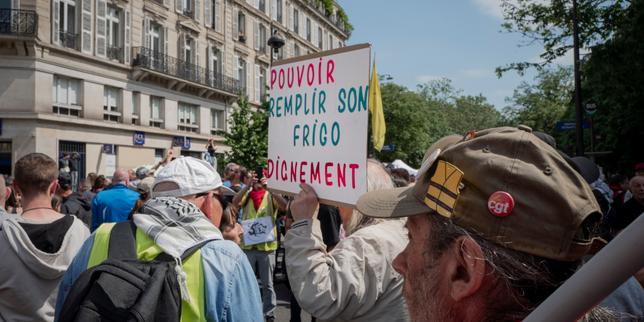
Every Tuesday morning, Jean-Pierre walks past the rusted skeleton of the metallurgical plant where his father worked for thirty years. The factory is silent now, replaced by the low hum of an Amazon fulfillment center three miles down the road. Jean-Pierre doesn't work there. He drives an delivery van, navigating the winding roads of rural central France, watching the odometer click away while calculating if his paycheck will cover the rising cost of heating oil.
Two hundred miles away in a brightly lit Parisian café, a group of university graduates sips oat milk lattes while debating the nuances of carbon taxation and European fiscal policy.
They speak French. They vote, or used to vote, for the same political family. Yet, they live on different planets.
This is the fracture tearing at the throat of modern progressive politics. The intellectual left has built a magnificent cathedral of abstract policy, but they forgot to build a road that leads to Jean-Pierre’s front door. For decades, the working class was the bedrock of progressive ambition. Today, that bedrock has crumbled into resentment, leaving a void that the far right is more than happy to fill with a dangerous, nostalgic poison.
To understand how we got here, we have to look past the campaign slogans and look at the numbers that define our lives. Economist Thomas Piketty has spent a career tracing the invisible lines of wealth accumulation, and his diagnosis is stark. The left did not just lose an election. It lost its imagination.
The Great Divorce
Politics used to be simple to map. If you labored with your hands, you voted for the parties that promised to redistribute wealth, fund public schools, and protect you from the whims of unbridled capital. If you owned the factory, you voted for the other side.
Then came the 1990s.
A subtle transformation occurred. Progressive parties across the West shifted their gaze. They became the parties of the highly educated, the urban professionals, and the winners of globalization. It was a gradual migration. As the left focused on societal progress and technocratic management, it quietly abandoned the economic radicalism that had defined its greatest triumphs.
Consider a hypothetical family in a small post-industrial town. Let's call them the Durands. In 1980, the Durands felt protected by a robust welfare state and an ambitious political platform that promised to narrow the gap between the rich and the poor. Fast forward to today. The local hospital has closed its maternity ward. The trains run less frequently. The schools are underfunded. When the Durands look at the modern political left, they do not see champions. They see a distant elite that lectures them about their carbon footprint while they struggle to buy gas to get to work.
The numbers back up this lived reality. Piketty’s research reveals a striking historical reversal. In the mid-twentieth century, the left-wing vote was overwhelmingly concentrated among voters with lower levels of education and income. Today, it is precisely the opposite. The left has become the "Brahmin Left," a coalition of the highly educated, while the wealthy conservative elite remains intact.
The working class? They have been left out in the cold, politically homeless, or drifting toward the nationalist right out of sheer desperation.
The Mirage of Meritocracy
We were told a lie about meritocracy. The story went like this: if you work hard and get a good education, you will succeed, regardless of where you started. It sounds beautiful. It feels fair.
But it is a trap.
When education becomes the sole determinant of political alignment and social value, inequality changes its face. It becomes moralized. The winners of the system believe they earned their success through sheer intellect and effort, while the losers are made to feel that their stagnation is their own fault.
This creates a profound cultural humiliation. A worker in a logistics warehouse knows that the system is rigged against them. They see top executive salaries skyrocketing while their own wages barely track inflation. When the political left adopts the language of this false meritocracy, it validates the rigging. It tells the worker that their struggles are merely a lack of adaptability to the modern economy.
The real problem lies elsewhere. It is not that working-class people do not want to adapt. It is that the ladder has been pulled up.
Let’s look at wealth distribution through an intuitive analogy. Imagine a game of Monopoly where one player starts with eighty percent of the properties and all the cash, while the other three players share the remaining scraps. No matter how hard those three players roll the dice, no matter how clever their strategy, the outcome of the game was decided before the first turn. That is the reality of inherited wealth and concentrated capital today. The top ten percent own the vast majority of the world's assets, while the bottom half owns virtually nothing but debt.
The left used to promise to redistribute the properties on the board. Now, they offer evening classes on how to roll the dice better.
Reclaiming the Egalitarian Engine
If the progressive movement wants to survive, it must remember its original purpose. It must return to what Piketty calls the egalitarian ambition of the past. This does not mean a faint-hearted tweak to the tax code or a minor subsidy for electric vehicles. It requires a fundamental restructuring of economic power.
The historical precedents are right in front of us. The decades following World War II saw the creation of the modern social state. It was a time of massive investments in public infrastructure, progressive taxation that kept extreme wealth in check, and a shared belief that a society's health is measured by the well-being of its poorest citizens.
That system was not built by compromising with financial markets. It was built by mobilizing a broad coalition that united the urban proletariat with rural workers.
To recreate that magic, the left needs a platform that speaks to Jean-Pierre in his delivery van just as clearly as it speaks to the graduate in the Parisian café.
What does that look like in practice?
It starts with a universal capital endowment. Imagine if every young adult, upon turning twenty-five, received a lump sum from the state—say, one hundred and twenty thousand euros—funded by a progressive tax on wealth. Suddenly, the son of a supermarket cashier has the same leverage to buy an apartment or start a business as the daughter of a corporate lawyer. It changes the power dynamic of society. It gives everyone a stake in the game.
It means universal access to high-quality public services, regardless of geography. A citizen living in a forgotten village in the Creuse department deserves the same quality of healthcare, digital connectivity, and education as someone living in the center of Lyon. When public services are dismantled, inequality deepens, and trust in the democratic project dissolves.
The Geography of Resentment
The battlefield of modern politics is no longer just between classes; it is between territories.
The major metropolitan areas have become hyper-prosperous hubs connected to global networks of capital and culture. Meanwhile, the peripheries—the small towns, the rural communes, the former industrial heartlands—are treated as economic deserts, useful only as reservoirs of cheap labor or locations for fulfillment centers.
This geographical divide feeds the political monster of our time. When a community feels abandoned by the state, it turns inward. It becomes susceptible to the siren song of nationalism, which promises protection by excluding others.
The far right does not offer real economic solutions to these territories. They do not propose wealth taxes or worker co-determination in corporate governance. But they do offer recognition. They validate the anger. They look at the forgotten towns and say, "We see you, and we know who stole your future."
The left cannot counter this with charts and technocratic arrogance. They cannot win by telling rural voters that their anger is economically illiterate or socially backward.
Victory requires a presence. It requires showing up in the community halls, the local markets, and the small-town squares. It means building an economic narrative that links the struggle of the underpaid nurse in a suburban hospital with the struggle of the farmer facing climate catastrophe.
Their enemy is the same: an economic system that commodifies everything and values nothing but short-term financial return.
The Invisible Stakes
We are running out of time.
The current political trajectory is unsustainable. If the progressive movement remains a club for the culturally enlightened urban elite, the working class will continue its march toward authoritarian alternatives. That path leads to the dismantling of democratic institutions, the scapegoating of minorities, and the ultimate preservation of the status quo for the ultra-wealthy, who always find a way to thrive under authoritarian regimes.
This is not a theoretical exercise for academic journals. It is the defining struggle of our generation.
The subject can feel overwhelming. The machinery of global finance seems too massive to alter, the political polarization too deep to heal. It is easy to succumb to cynicism, to believe that we are merely passengers on a ship heading toward the rocks.
But history is not a straight line. It is a series of sharp turns, driven by ideas that captured the human imagination. The welfare state was an impossible dream until it became a reality. The eight-hour workday was an absurdity until workers demanded it.
The compass can be fixed.
It requires the left to look down at its own boots, muddy from the fields and the factory floors of the past, and remember how to walk among the people it was born to defend.
The delivery van rolls to a stop at the edge of a darkened village. Jean-Pierre steps out into the cold night air, his shoulders aching from twelve hours behind the wheel, looking at the distant lights of a country that has forgotten he exists.