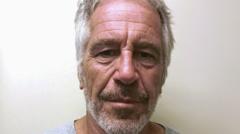
The Ministry of Defence has finally been forced to open its ledger on Jeffrey Epstein. For years, the question of how a convicted sex offender moved with such apparent ease through high-security corridors remained a matter of whispered speculation in Whitehall. Now, an internal review is underway to determine if, and how often, Epstein’s private fleet utilized Royal Air Force (RAF) facilities. This is not merely a logistical inquiry into landing fees or hangar space. It is a direct challenge to the integrity of British sovereign territory and the gatekeepers who manage it. If Epstein used these bases, he didn’t just bypass civilian customs; he effectively utilized the British military as a private concierge service.
The scope of this investigation centers on several key RAF locations, most notably RAF Northolt in West London and RAF Brize Norton in Oxfordshire. Northolt, in particular, has long served as the preferred arrival point for the Royal Family, senior government ministers, and visiting heads of state. Its proximity to central London and its layers of military security make it the ultimate "discreet" entry point. For a man like Epstein, whose entire operation relied on the perception of proximity to power, landing a private jet on a military tarmac was the ultimate badge of legitimacy.
The Mechanics of Military Access
Gaining entry to an RAF base isn't as simple as filing a flight plan with Heathrow. It requires specific authorization, often linked to diplomatic clearance or high-level sponsorship. The MoD review is currently scouring movement logs and "Special Handling" requests from the early 2000s through 2019. They are looking for the tail numbers associated with Epstein’s fleet, including the infamous Boeing 727 and his Gulfstream jets.
Military airfields operate under different oversight mechanisms than commercial hubs. At a civilian airport, passengers are processed by Border Force in a standardized, high-volume environment. At an RAF base, the process is intimate. Security is handled by military police, and the manifest is often cleared in advance through departmental channels. If Epstein was landing at Northolt, someone within the British establishment likely had to sign off on his arrival. This raises the uncomfortable prospect of "social engineering" within the military hierarchy. We are looking for the names on those sponsorship forms.
The investigation must bridge the gap between documented flight logs and the "ghost flights" that often plague private aviation. It is a tedious, manual process of cross-referencing fuel receipts, landing logs, and ground handling invoices. In many cases, these records are archived in physical formats that were never intended for this level of forensic scrutiny.
The Royal Connection and the Shield of Immunity
One cannot discuss Epstein’s potential access to military assets without addressing the elephant in the room. Prince Andrew’s long-standing association with the financier provided a veneer of officialdom that few others could claim. As a former naval officer and a then-working royal, the Duke of York had significant sway over military protocol.
The suspicion among investigators is that Epstein may have been "embedded" in royal travel arrangements. If a private jet is flying under the umbrella of a royal visit or a high-level diplomatic meeting, the standard vetting procedures can soften. This is the "halo effect" of prestige. Security officers are trained to spot threats, but they are less prepared to challenge a guest of the monarchy.
Evidence suggests that the misuse of these bases would have provided Epstein with more than just convenience. It offered a "dark channel" for transporting individuals without the scrutiny of standard immigration checks. If a young woman was traveling on a private jet categorized as a "guest of the state" or attached to a high-priority manifest, her presence might never have been recorded in the national border database. This is the core of the scandal. It is the possibility that the RAF unknowingly facilitated the movement of victims.
Flaws in the Oversight Chain
The British military is a machine built on hierarchy and orders. When an order comes down to accommodate a VIP, the personnel on the ground rarely ask for a criminal background check. This structural deference is a massive security loophole.
The Problem with Discretionary Clearances
- Sponsorship Gaps: Currently, a high-ranking official can sponsor a "civilian visitor" for base access without an exhaustive vetting process if the visit is deemed in the national interest.
- Manifest Ambiguity: Private manifests for non-scheduled flights are often less detailed than commercial ones, sometimes listing "Guests of [Name]" rather than individual identities.
- The Private-Public Blur: The line between a private business trip and a semi-official diplomatic mission was frequently blurred during the era of Epstein’s peak influence.
These gaps were not accidental. They were features of a system designed to afford privacy to the powerful. However, when that privacy is used to shield illicit activity, the system becomes an accomplice. The MoD's review is an admission that the current safeguards were, at best, naive.
The Global Web of Airfield Influence
Epstein’s strategy was consistent across borders. In the United States, he frequently used his private island in the U.S. Virgin Islands as a sovereign-like entity. In the UK, he sought the equivalent. By utilizing RAF bases, he wasn't just avoiding the paparazzi; he was testing the limits of his immunity.
Compare this to the 2002 incident where Epstein was reportedly hosted at Sandringham. The logistics of moving a man of his notoriety into the inner sanctum of the British state required a level of coordination that suggests a systemic failure. The MoD review is now looking at whether this coordination extended to the tarmac. If the flight logs show a pattern of arrivals coinciding with royal events or private hunting parties, the narrative shifts from "individual lapse in judgment" to "institutional negligence."
The financial aspect is also under fire. RAF bases charge "landing and housing" fees for civil aircraft. Investigators are tracing the money trail to see if these payments were made through offshore accounts or front companies. Identifying the source of the funds used to pay the MoD could reveal a broader network of enablers who were financing Epstein's British logistics.
Accountability and the Paper Trail
The primary hurdle for this investigation is time. Many of the personnel who managed airfield operations during the key years of 2002 to 2010 have since retired or moved to the private sector. The "institutional memory" of the RAF is being tested. However, the flight logs themselves—the physical "movement books"—are harder to erase.
The MoD has a legal obligation to maintain these records for decades, especially when they involve foreign nationals and private aviation. The pressure is now on the Secretary of State for Defence to release a full accounting of these flights to the public. Anything less than a transparent list of dates, tail numbers, and sponsors will be viewed as a cover-up.
This isn't just about Jeffrey Epstein anymore. It is about whether the British military can be "rented" by the highest bidder or the best-connected socialite. The review must address whether the RAF was used as a tool for human trafficking, even inadvertently. To ignore that possibility is to fail the victims who have spent decades seeking the truth.
The military prides itself on defending the realm. If that same military provided a safe harbor for a predator, the betrayal of the public trust is absolute. We are waiting for the logs to speak. They usually do, eventually, if you dig deep enough into the archives of the state.
The fallout from this review will likely lead to a total overhaul of how private citizens interact with military infrastructure. The days of "nod and a wink" access are over. Security in the modern era doesn't just mean checking for bombs; it means checking the character of the people we allow past the wire. The MoD is learning this lesson the hard way, through the lens of one of the most sordid criminal cases in modern history.


