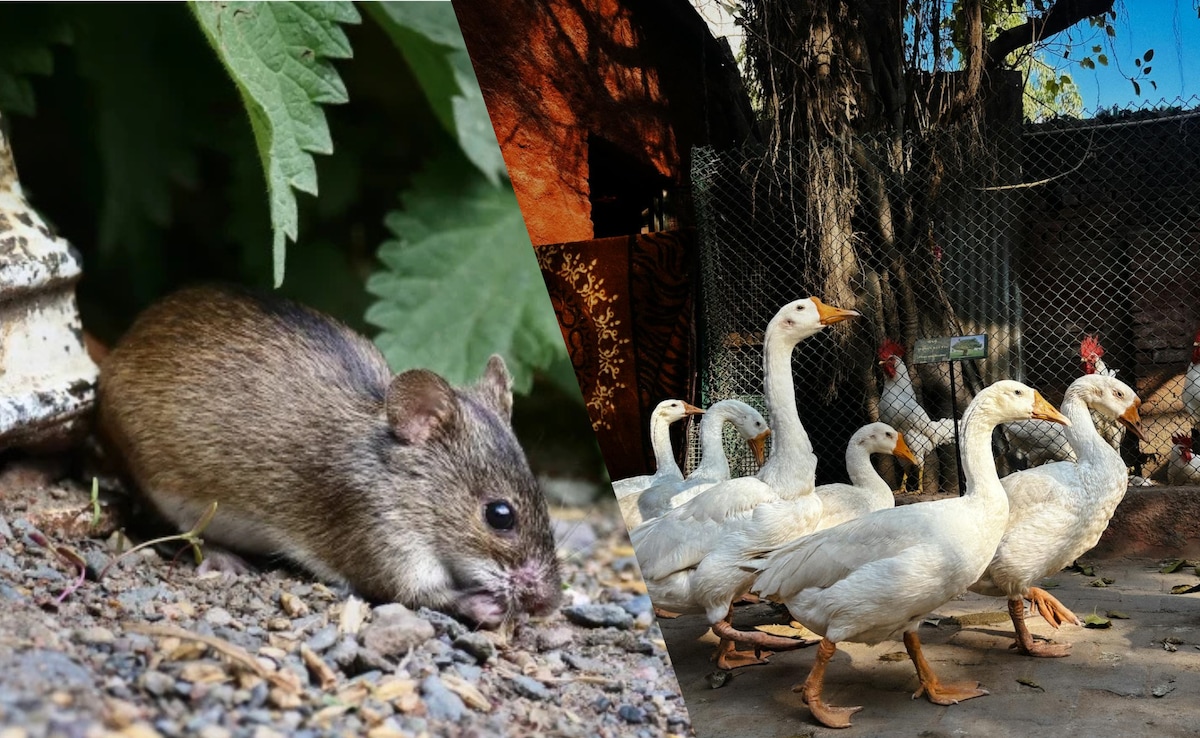
In the high, dry silence of the Four Corners region, a man named Elias clears out a long-abandoned shed. Dust motes dance in the shafts of Southwestern light. He breathes deeply, unaware that the air he inhales carries a microscopic cargo left behind by the deer mice nesting in the rafters. Thousands of miles away, in a humid market in Southeast Asia, a woman brushes past a cage of chickens. A single feather drifts upward. She catches it, tosses it aside, and keeps walking.
These two moments represent the front lines of a silent, biological war. Elias is facing the Hantavirus. The woman in the market is brushing against H5N1, the Avian Influenza. On paper, both are categorized as zoonotic threats—diseases that jump from animals to humans. But the mechanics of how they move, how they kill, and how they threaten our collective future are as different as a sniper’s bullet is from a wildfire.
The Ghost in the Dust
The Hantavirus is a creature of isolation. It does not need a crowd to be deadly. It waits in the waste of rodents, tucked away in the dark corners of cabins, sheds, and barns. When that waste dries, the virus becomes part of the air. It is a literal ghost in the machine of our rural lives.
When Elias breathes in that dust, the virus finds a home in the lining of his lungs. It doesn't cause a cough at first. It mimics a common flu—fever, muscle aches, exhaustion. But within days, the lungs begin to fill with fluid. This is Hantavirus Pulmonary Syndrome (HPS). It is a brutal, rapid descent.
Here is the terrifying reality: Hantavirus is incredibly lethal. In North America, the mortality rate is roughly 38%. It kills more than one out of every three people it touches. Yet, for all its individual violence, it is a clumsy traveler. It hits a dead end when it reaches a human. With rare exceptions noted in South America involving the Andes strain, the virus does not pass from person to person. It is a tragedy contained within a single room. It is a lonely death.
The Velocity of the Wing
The Avian Influenza, or "bird flu," plays by an entirely different set of rules. While Hantavirus is a hermit, Bird Flu is a socialite. It thrives on the interconnectedness of our world. It travels on the wings of migratory ducks and in the cargo holds of industrial poultry transport.
Consider the sheer scale of the potential contact zone. Every year, billions of birds traverse the globe, crossing borders without passports, dropping the virus into backyard coops and massive commercial farms alike. When the virus jumps to a human, the stakes shift. We aren't just worried about the person who got sick; we are worried about who they talked to on the bus, who they hugged at dinner, and who they sat next to on a flight to London.
The spread is governed by a mathematical value known as $R_0$ (R-naught), which represents the average number of people one infected person will pass the virus to. For Hantavirus, that number is effectively zero. For a pandemic-capable strain of Bird Flu, that number could be significantly higher than one. That is the difference between a localized medical emergency and a global shutdown.
The Mechanics of the Jump
Why does one spread like a wildfire while the other flickers out like a match? It comes down to the receptors.
Hantavirus targets the endothelial cells—the tiny bricks that make up your blood vessels. It turns those vessels into leaky pipes. Because the damage is so deep and so specific to the individual’s internal plumbing, the virus rarely finds its way back out into the air in a high enough concentration to infect another person. It stays locked inside the body it is destroying.
Bird Flu is a master of the upper respiratory tract. It lives where we breathe, talk, and sneeze. It is designed for exit and entry. For years, the saving grace has been that most avian strains prefer the receptors deep in the lungs, making them hard to catch but very deadly once you have them. But viruses are restless. They mutate. They swap pieces of their genetic code like children trading cards. This process, called reassortment, is the nightmare scenario. If a bird flu strain learns to bind to the receptors in our noses and throats as easily as the common cold does, while maintaining its high lethality, the math of human civilization changes overnight.
The Geographic Trap
We often think of viruses as global entities, but they are bound by the ecology of their hosts. The Hantavirus is tethered to the mouse. Where the mouse goes, the virus goes. In the United States, that means the Southwest is a hotspot, but you aren't going to catch it in a high-rise in Manhattan unless a deer mouse has hitched a very long ride.
Bird Flu is untethered. It is an atmospheric threat. In 2024 and 2025, we watched as H5N1 moved from birds into dairy cattle in the United States, a jump that surprised even the most seasoned virologists. It moved from the wing to the hoof. Every time the virus enters a new mammal—be it a cow, a pig, or a person—it gets a fresh laboratory to test out new mutations.
The "speed" of an infection isn't just about how fast a person gets sick. It’s about how fast the virus moves across a map. Hantavirus moves at the speed of a rodent's scamper. Bird Flu moves at the speed of a jet stream.
The Human Element of Risk
Imagine the stress on a local healthcare system. If a cluster of Hantavirus cases appears in a rural county, it is a localized crisis. The doctors need ventilators, and they need them fast. But they don't need to lock down the town. They don't need to worry about the grocery store clerk becoming a superspreader.
Now imagine a confirmed case of human-to-human bird flu in a major city. The response is not just medical; it is psychological and economic. The "speed" here is accelerated by fear. People stop traveling. Supply chains buckle. The viral spread is shadowed by a spread of panic that moves even faster than the pathogen itself.
We are currently living in a period of unprecedented surveillance. Scientists are scouring wastewater, testing milk, and swabbing the throats of farmworkers. They are looking for the "tell"—that specific genetic shift that indicates the virus has learned the secret handshake of human-to-human transmission.
The False Sense of Security
There is a danger in comparing these two. We tend to look at Hantavirus and think, "It’s rare, so I don't need to worry," or look at Bird Flu and think, "It hasn't happened yet, so it’s just a scare tactic."
Both views are traps.
Hantavirus teaches us about the lethality of our environment. It reminds us that nature is not always a benevolent backdrop for our hikes and cabin retreats; sometimes, it is a reservoir of ancient, silent killers. It demands respect for the boundaries between our domestic spaces and the wild.
Bird Flu teaches us about our fragility as a global species. It exposes the reality that a sneeze in a distant province is a heartbeat away from our own front doors. It demands a level of international cooperation that we have historically struggled to maintain.
The Invisible Stakes
If you asked Elias, struggling for air in a sterile hospital room, which virus was "faster," the question would seem absurd. For him, the virus moved with the speed of a lightning strike. His world contracted to the size of a ventilator mask in forty-eight hours.
But if you ask a public health official watching the migratory patterns of geese across the Pacific Flyway, the answer is different. They see the slow-motion car crash of a potential pandemic. They see a virus that is "fast" because it is patient, waiting for the right mutation, the right host, and the right moment to go global.
One is a tragedy of the individual. The other is a threat to the collective.
We often want a simple answer—a winner in the race of terror. But the truth is that we are caught between the breath and the wing. We live in the tension between the dust in our attics and the birds in our skies.
The real question isn't which virus spreads faster. It's whether we can learn to see the invisible threads connecting us to the natural world before those threads become fuses. We are not separate from the ecosystems we inhabit. We are part of the exchange. Every breath is a risk, and every flight is a bridge.
A single mouse in a shed. A single feather in a market. The world turns on these small, quiet things.