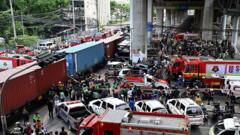
A train crashes. Passengers are injured. The headlines practically write themselves the moment the toxicology report drops. "Driver tests positive for drugs." Instantly, the public collective exhales. The villain has been identified. The narrative is neat, tidy, and completely wrong.
When a Thai commuter train smashes into a buffer or another chassis, and the police rush to announce the operator had illicit substances in their system, they are handing the public a scapegoat on a silver platter. It is a masterclass in corporate and bureaucratic misdirection. By focusing entirely on the moral failure of a single employee, we ignore the catastrophic systemic failures that actually cause mass transit disasters.
I have spent nearly two decades auditing industrial supply chains and safety-critical automation systems. I have seen organizations spend millions covering up architectural rot by sacrificing a front-line worker to the court of public opinion. The "bad apple" theory is a lie told by executives who do not want to fund structural redundancy.
Blaming a positive drug test for a train derailment is like blaming the rain for a leaky roof. The rain exposed the hole, but it did not punch it there.
The Illusion of the Single Point of Failure
Modern rail infrastructure is supposed to be designed under a strict engineering principle: no single human error should ever result in a catastrophe. If a system can be brought down because one person skipped sleep, had a panic attack, or took an illegal substance, that system is fundamentally broken.
In high-reliability organizations, we talk about the Swiss Cheese Model of accident causation. For an accident to happen, holes in multiple layers of defense must line up perfectly.
- The Behavioral Layer: The operator's state of mind or impairment.
- The Technological Layer: Automatic Train Protection (ATP) and positive train control systems.
- The Supervisory Layer: Real-time dispatch tracking and remote intervention.
- The Infrastructural Layer: Mechanical fail-safes, catch sidings, and physical buffers.
When an operator fails, the technological and supervisory layers are supposed to instantly take over. Automatic braking systems do not care if a driver is high, drunk, or dead of a heart attack. They monitor track speed, signal violations, and closing distances. If the train exceeds safe parameters, the system trips.
Therefore, when a train crashes, the relevant question is not "What was in the driver's bloodstream?" The only question that matters is: Why did the automatic fail-safes fail to override human error?
Focusing on the toxicology report allows transit authorities to dodge the multi-million-dollar conversation about why their signaling network is obsolete, why their automatic braking systems were bypassed, or why their dispatchers were asleep at the wheel. It turns a complex engineering failure into a simple morality play.
The Toxic Reality of Post-Accident Drug Testing
Let us dismantle the science of the post-accident drug headline.
When a police spokesperson announces a positive test, the public assumes the driver was actively hallucinating behind the controls. This shows a complete ignorance of pharmacokinetics and testing methodologies.
Standard immunoassay urine screens detect metabolites, not active impairment. A driver who smoked cannabis three weeks ago in their own home can test positive today. A driver who took an over-the-counter cold medication containing pseudoephedrine can trigger a false positive for amphetamines. In rapidly developing transport hubs throughout Southeast Asia, workers frequently rely on cheap, unregulated stimulant drinks or low-grade amphetamines just to survive grueling 16-hour shifts forced upon them by understaffed management.
Am I defending operating heavy machinery under the influence? Absolutely not. It is reckless. But conflating a positive metabolite test with the root cause of a kinetic disaster is junk science used to manage public relations.
If a train's signaling system works, an impaired driver can pass out entirely, and the train will simply stop at the next red signal. If the train keeps moving and crashes, the primary cause of the crash is a signaling failure, not a human failure.
The Economics of Scapegoating
Replacing a legacy rail signaling infrastructure with modern communications-based train control costs hundreds of millions of dollars. It requires shutting down lines, upgrading rolling stock, and rigorous third-party auditing.
Firing a driver and issuing a press release costs nothing.
This is the grim calculus of transit management. By framing accidents as isolated incidents of human depravity, operators protect their capital budgets. Insurance companies settle claims faster when liability can be pinned on an rogue employee acting outside of corporate policy, rather than a systemic pattern of maintenance deferral by the operator.
Look at the history of industrial disasters worldwide. When the Herald of Free Enterprise ferry capsized in 1987, killing 193 people, initial blame fell squarely on the assistant bosun who was asleep in his bunk instead of closing the bow doors. It took a rigorous inquiry to reveal that the company culture routinely pressured captains to sail before the doors were closed to maintain tight schedules, and management had refused to install a cheap indicator light on the bridge to show whether the doors were shut.
The Thai rail system, much like rapidly expanding networks in India or Indonesia, faces immense pressure to move millions of people daily with inadequate budgets. Workers are pushed to the brink of exhaustion. When you run humans ragged in an environment lacking automated safeguards, you are playing Russian roulette. The drug test is just the bullet you happened to find in the chamber after the gun went off.
Dismantling the Premise of Public Outrage
Whenever these incidents occur, public forums fill with the same tired questions. Let us answer them honestly by exposing how flawed the premises are.
Shouldn't random drug testing prevent these accidents entirely?
No. Random drug testing is a theater of compliance. It catches the occasional casual user but does virtually nothing to prevent acute impairment or exhaustion-driven substance abuse on the day of a shift. Furthermore, it creates a culture of fear where employees hide chronic fatigue and medical issues rather than seeking help, making the entire system vastly more dangerous.
If the driver was sober, wouldn't they have hit the brakes?
Maybe. Maybe not. Human reaction times are notoriously unreliable in high-speed environments. A driver faces sudden track obstructions, unexpected signal changes, or sudden mechanical failure of the braking system itself. Relying on a human being's reflexes as your primary line of defense in a 500-ton steel projectile is an engineering crime.
Why not just install cameras to monitor drivers for impairment in real-time?
Because inward-facing cameras are a cheap, dystopian bandage on a severed limb. They do not prevent a crash if a driver suffers a sudden stroke, a micro-sleep episode, or a momentary distraction. Instead of spending money spying on employees to catch them slipping, that capital must be deployed into positive train control hardware that renders driver impairment irrelevant to passenger safety.
The Actionable Truth Nobody Wants to Face
If we want to stop trains from crashing, we have to stop treating operators like independent agents operating in a vacuum. They are components in a complex machine. When a component fails, you look at the engineering tolerances of the machine that allowed that failure to propagate.
The downside to this contrarian view is obvious: it is incredibly expensive. It demands that we stop accepting the cheap satisfaction of public hangings and start demanding massive, disruptive capital investments in automated infrastructure. It means acknowledging that our favorite public transport systems might need to be shut down or severely slowed while safety networks are rebuilt from scratch.
Until we shift our focus from the biology of the driver to the architecture of the network, every safety press release issued by transit authorities is a farce.
Stop looking at the toxicology screen. Start looking at the capital expenditure budget. That is where the real crimes are committed.