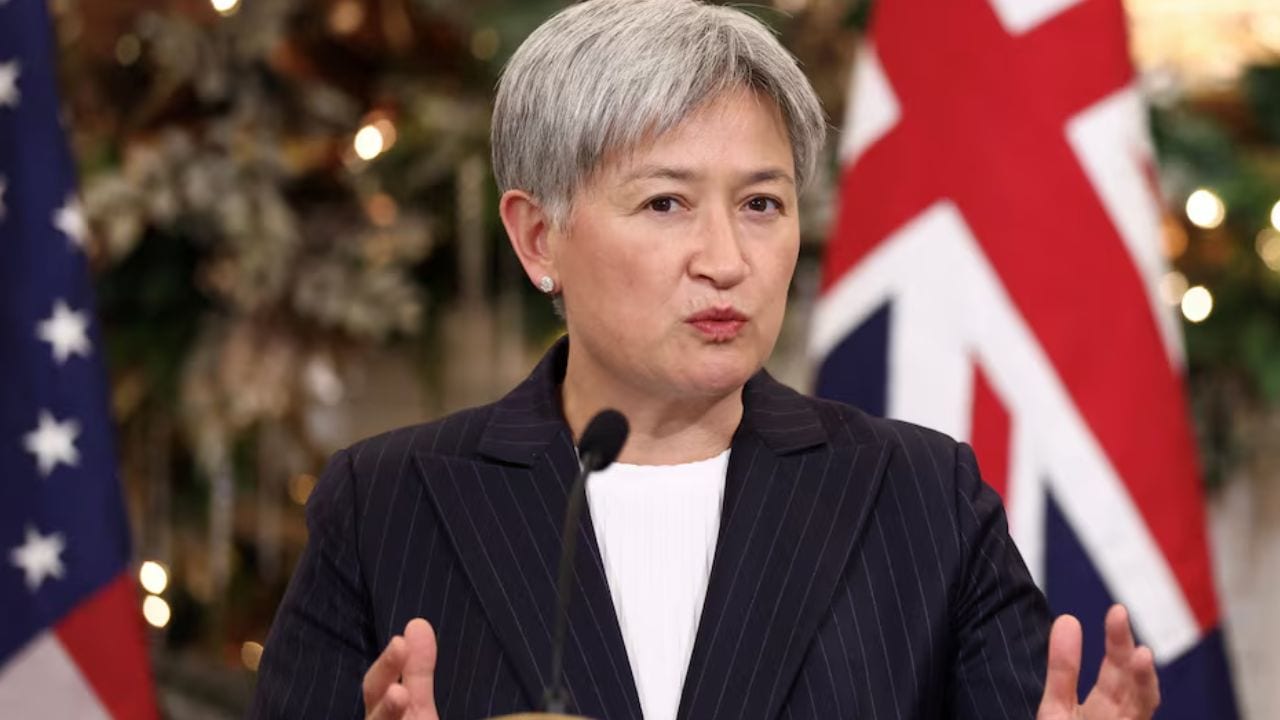
Foreign Minister Penny Wong landed in Tokyo this week with a heavy brief and a desperate mission. Nominally, it is a diplomatic tour of Japan, China, and South Korea to discuss "shared energy security." In reality, it is a high-stakes scavenger hunt. Australia, a nation that prides itself on being an energy superpower, has found itself in the humiliating position of a beggar at the gates of North Asia’s refineries. The closure of the Strait of Hormuz has not just disrupted global markets; it has exposed the hollow core of Australia’s domestic fuel policy.
The math is as simple as it is terrifying. Around 80% of the oil destined for the Indo-Pacific traditionally moves through that single, now-choked artery. Australia, having shuttered the vast majority of its domestic refining capacity over the last decade in favor of "market efficiencies," is now entirely beholden to the sophisticated refineries of Seoul, Tokyo, and Beijing. Wong isn't just there to shake hands. She is there to barter Australia’s remaining leverage—liquefied natural gas (LNG) and thermal coal—to ensure that when the refined fuel ships leave North Asian docks, they are pointed toward Sydney and Melbourne rather than being hoarded for domestic use.
The Refined Fuel Trap
For years, Canberra operated under the delusion that "just-in-time" delivery was a permanent feature of the geopolitical landscape. By allowing domestic refineries to rust away, Australia outsourced its sovereignty to South Korea and Japan. Now that the Middle East is in flames and the Strait is closed, those partners are looking at their own dwindling stockpiles.
South Korea is Australia’s primary source of refined diesel and jet fuel. Without a constant flow from Korean ports, the Australian trucking industry—the literal lifeblood of the nation's grocery and medical supply chains—grinds to a halt within three weeks. Wong’s meeting with Foreign Minister Cho Hyun in Seoul isn't a courtesy call. It is a plea for priority.
The leverage being used is a "quid pro quo" that borders on the transactional. Australia is essentially telling Seoul and Tokyo that if they want the coal and gas required to keep their power grids from collapsing, they must continue to export refined petroleum products to Australia, even if their own domestic prices are skyrocketing. It is a diplomatic hostage exchange where the hostages are energy commodities.
The Beijing Tightrope
The stop in Beijing to meet Wang Yi for the eighth Australia-China Foreign and Strategic Dialogue is the most fraught leg of the journey. While Japan and South Korea are allies, China is a competitor that happens to control a massive portion of the regional supply of urea—the critical component in AdBlue, without which modern diesel engines simply will not run.
Australia’s trade surplus with China has been narrowing. In 2021, it sat at $45 billion; by 2025, it had compressed to $19 billion as China ramped up exports of high-value machinery and electronics while Australia’s commodity prices softened. This shifting balance of power gives Beijing the upper hand. If China decides to prioritize its own industrial stability by restricting fuel and fertilizer exports, Australia has very few cards left to play.
Wong must maintain the "stable and constructive" tone that has been the hallmark of the Albanese government, but the subtext is survival. Beijing knows that Australia’s dependence on Chinese industrial inputs—from aviation fuel to fertilizer—is a strategic vulnerability that can be poked whenever Canberra gets too loud about regional security.
Why the Barter Might Fail
- Domestic Pressure: As fuel prices hit record highs in Tokyo and Seoul, the leaders of those nations will find it politically impossible to export fuel to Australia while their own citizens wait in line at the pump.
- The China Factor: Beijing has already shown a willingness to use trade as a weapon. If the strategic dialogue goes poorly, the "prioritized access" Wong is seeking could evaporate overnight.
- Refining Bottlenecks: Even if the political will exists, the logistical reality of the Hormuz closure means there is simply less crude to refine. You cannot export what you do not have.
The Illusion of the Energy Superpower
There is a bitter irony in an Australian Foreign Minister traveling to Japan—a country with almost no natural resources—to secure energy security. Australia sits on some of the largest gas and coal deposits on earth, yet its citizens are facing the prospect of "wartime-style" rationing. This is the result of a decade of policy failure that prioritized export profits over domestic resilience.
The current crisis has forced Energy Minister Chris Bowen to admit that 283 service stations across Australia ran dry over the Easter period. Demand for diesel is up 30%, driven by panic buying and a desperate logistics sector. The government’s response has been to "leverage" our gas, but much of that gas is already locked into long-term contracts with the very countries Wong is visiting. We are effectively selling them the fuel to cook the meal, then asking if we can have a few leftovers.
The Real Cost of Priority
Seeking "priority access" is a polite way of asking our neighbors to suffer so we don't have to. When Wong asks Japan’s Motegi Toshimitsu to ensure Australia is "prioritized" for fuel shipments, she is asking Japan to divert resources away from its own struggling economy. This creates a friction that no amount of "shared values" or "Special Strategic Partnerships" can fully lubricate.
The trip is a temporary fix for a structural hemorrhage. Even if Wong returns with signed assurances, those documents are only as good as the next week’s crude oil inventory. The fundamental problem remains: Australia has the raw materials but has lost the ability to process them. Until the nation rebuilds its own refining and chemical manufacturing base, the Foreign Minister will remain a perpetual commuter to North Asia, trading away Australia’s mineral wealth just to keep the lights on and the trucks moving for another month.
The era of cheap, easy energy is over. The era of the desperate barter has begun.