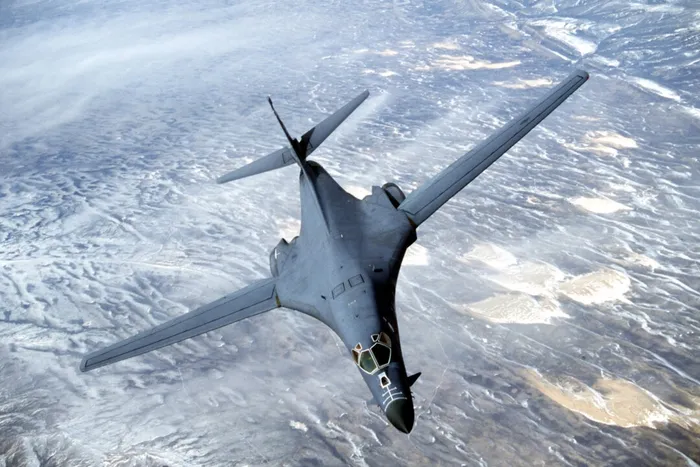
The recent deployment of B-1B Lancer heavy bombers into Iranian-adjacent airspace marks a shift from passive deterrence to active posturing. While U.S. Central Command (CENTCOM) often frames these flights as routine exercises in regional stability, the reality is a calculated demonstration of long-range penetration capabilities. This isn't just about flying planes; it is about signaling to Tehran that the geographic depth of its nuclear and military infrastructure no longer provides the sanctuary it once did.
By sending the "Bone"—as the B-1 is known in Air Force circles—near or potentially into sensitive corridors, Washington is making a loud statement about the reach of conventional munitions. The B-1B carries the largest conventional payload of both guided and unguided weapons in the U.S. Air Force inventory. Its presence suggests that the window for purely diplomatic maneuvering is narrowing, replaced by a kinetic backup plan that is now being flight-tested in real-time.
The Architecture of a Long Range Strike
The B-1B Lancer is a relic of the Cold War that has found a second life as a precision-strike powerhouse. Unlike the B-2 Spirit, which relies on stealth, or the B-52, which acts as a high-altitude truck for cruise missiles, the B-1 combines high speed with a massive internal bay. It is designed to fly low, fast, and heavy. When CENTCOM sends these assets "deep" into a theater, they are testing the response times of local integrated air defense systems (IADS).
Iran’s air defenses, anchored by the Russian-made S-300 and the domestic Bavar-373, are formidable on paper. However, a B-1 mission is never a solo act. These bombers move within a protective bubble of electronic warfare aircraft, F-15E Strike Eagles, and refueling tankers stationed over friendly territory. The objective of such a mission is twofold: to map the electronic signatures of Iranian radar as they "paint" the incoming bombers and to prove that the U.S. can sustain a high-tempo bombing campaign from bases as far away as Dyess Air Force Base in Texas or RAF Fairford in the UK.
Chokepoints and Sovereign Friction
The geography of the Persian Gulf and the Gulf of Oman creates a nightmare for mission planners. There is very little room to maneuver without clipping the territorial waters or airspace of a dozen different stakeholders. When reports surface of bombers moving "deep" into the region, it often implies a path through the Strait of Hormuz—a maritime chokepoint where 20% of the world's oil passes.
Tehran views these flights as a direct violation of their sphere of influence. From their perspective, the U.S. is not "maintaining stability" but rather practicing the opening salvos of a regime-change conflict. This creates a dangerous feedback loop. Every time a B-1 maneuvers near the Iranian coast, the Islamic Revolutionary Guard Corps (IRGC) puts its drone swarms and fast-attack boats on high alert. The risk of a mid-air collision or a misinterpreted radar lock-on grows with every sortie.
The Payload Factor
What makes the B-1 particularly threatening to Iran is its ability to carry the GBU-31 Joint Direct Attack Munition (JDAM) in massive quantities.
- The B-1B can carry up to 84 500-pound Mk-82 bombs.
- It can carry 24 2,000-pound GBU-31s.
- It is compatible with the AGM-158 JASSM (Joint Air-to-Surface Standoff Missile).
The JASSM, in particular, allows the Lancer to strike targets from hundreds of miles away, well outside the range of most Iranian surface-to-air missiles. If a flight is described as going "deep," it means the U.S. is signaling that even the standoff distance is being reduced, bringing the actual aircraft within visual or short-range radar distance of the target. This is psychological warfare as much as it is a military drill.
Regional Partners and the Silent Consent
These missions do not happen in a vacuum. A B-1 flight from the continental United States to the Middle East requires multiple mid-air refuelings and overflight permissions from allies like Saudi Arabia, Qatar, or the United Arab Emirates. The "deep" penetration of the region is a litmus test for these partnerships.
When a B-1 flies a mission that hugs the Iranian border, it confirms that neighboring Arab states are still willing to provide the logistical backbone for U.S. power projection, despite the public rhetoric about de-escalation. This silent consent is what Tehran fears most. It suggests a regional coalition that, while quiet, is prepared for a worst-case scenario involving Iranian ballistic missile sites or enrichment facilities like those at Natanz or Fordow.
The Hidden Costs of Bomber Diplomacy
There is a wear-and-tear aspect to these missions that rarely makes the headlines. The B-1 fleet is aging and notoriously difficult to maintain. Every long-duration mission into the Middle East eats into the remaining flight hours of a limited fleet. By using these bombers as "diplomatic signaling tools," the Pentagon is burning through its conventional strike capacity at a rapid rate.
Critics of this strategy argue that it reveals too much. By flying these routes repeatedly, the U.S. allows Iranian intelligence to study flight patterns, refueling tracks, and communication protocols. It is a gamble: do you intimidate the adversary into backing down, or do you provide them with the data they need to eventually shoot a bomber down?
The Nuclear Shadow
The timing of these flights often correlates with stalls in nuclear negotiations or spikes in proxy militia activity in Iraq and Syria. The B-1 serves as a bridge between "strong words" and "actual war." It is the most visible asset the U.S. has that can deliver a massive conventional blow without resorting to the nuclear-capable B-52 or B-2.
However, the distinction is lost on a radar operator in Tehran. A heavy bomber is a heavy bomber. The move to fly these assets deep into the theater is an admission that the previous layers of deterrence—carrier strike groups and drone patrols—have failed to change Iranian behavior. We are now in the era of "heavy" deterrence, where the size of the airframe is meant to compensate for the lack of a coherent regional policy.
The Question of Miscalculation
History is littered with "routine" missions that ended in catastrophe. In the congested corridors of the Middle East, the margin for error is razor-thin. A navigational error, a mechanical failure leading to an emergency landing on the wrong side of a border, or a panicked air defense commander could turn a show of force into an international crisis.
The U.S. is betting that Iran will see the B-1 and retreat. Iran is betting that the U.S. is too stretched thin globally to actually use them. This is a game of chicken played with 400,000-pound aircraft and thousands of tons of explosives. As long as these flights continue to push deeper into sensitive zones, the question isn't whether a message is being sent, but whether anyone is left to interpret it calmly.
The Bone is back in the desert, and its presence indicates that the military options are no longer just sitting on a desk in the Oval Office—they are currently at 30,000 feet, heading east.
Keep a close eye on the refueling tracks over Jordan and the North Sea; that is where the real story of the next strike will begin.