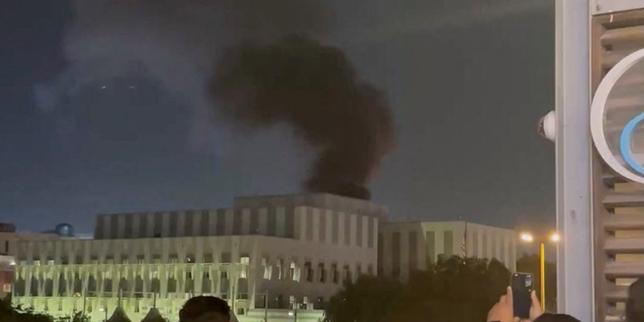
The recent drone activity targeting the United States Consulate in Dubai represents more than a localized security breach; it is a manifestation of the collapsing cost of precision disruption. While traditional kinetic warfare requires massive logistical footprints, the democratization of unmanned aerial systems (UAS) allows non-state actors or proxy elements to project power into highly fortified, high-value urban environments. This incident exposes a fundamental misalignment between traditional "hardened" diplomatic infrastructure and the agility of low-altitude, low-observable threats.
The Triad of Asymmetric Vulnerability
The effectiveness of a drone-based approach against a diplomatic facility rests on three distinct operational pillars. Security forces must address these as a cohesive system rather than isolated variables.
- Signal Saturation and Detection Latency: In a dense urban environment like Dubai, the electromagnetic spectrum is crowded with civilian Wi-Fi, cellular signals, and commercial radio frequencies. Identifying a rogue drone controller’s signal among this noise is an exercise in high-fidelity filtering. The delay between initial detection and positive identification creates a "threat window" where defensive measures may arrive too late to prevent a kinetic impact or a surveillance breach.
- The Proximity-to-Risk Ratio: Diplomatic facilities are often located in central business districts or high-traffic zones to maintain accessibility. This proximity limits the use of kinetic countermeasures—such as physical projectiles or high-energy lasers—due to the extreme risk of collateral damage to surrounding civilian infrastructure and personnel.
- Economic Disproportionality: The cost-to-counteract ratio is heavily skewed. A commercial off-the-shelf (COTS) drone costing less than $2,000 can force the activation of defense systems and diplomatic protocols costing millions in operational downtime, security deployment, and political capital.
Mechanics of the Low-Altitude Breach
The incident highlights a specific failure point in traditional perimeter security: the transition from 2D to 3D defensive logic. Standard consulate security is designed for ground-based intrusions, focusing on blast walls, bollards, and biometric access points. A drone bypasses these 2D barriers entirely by exploiting the "unprotected ceiling" of the facility.
Navigation and Target Acquisition
Modern UAS do not necessarily rely on GPS, which can be jammed or spoofed. Current iterations utilize visual odometry and edge-based AI processing to navigate via landmark recognition. This renders traditional electronic warfare (EW) "bubbles" less effective. If a drone is programmed to recognize the specific architectural silhouette of a consulate, it can maintain its flight path even when its connection to a remote pilot or a satellite constellation is severed.
The Intelligence Gathering Payload
While the immediate fear in such incidents is a kinetic strike (explosive delivery), the more insidious threat is the data-harvesting capability. High-resolution optical sensors and signals intelligence (SIGINT) packages can be mounted on small frames to map internal facility layouts, identify individual personnel movements, or intercept unencrypted local communications. The psychological impact of "persistent presence"—the knowledge that a facility is being observed from an angle security cannot easily close—serves as a primary tool for geopolitical signaling.
Structural Bottlenecks in Counter-UAS Deployment
Implementing a comprehensive defense against these incursions faces significant technical and legal bottlenecks.
- Frequency Deconfliction: Deploying wide-spectrum jamming to stop a drone risks shutting down the very communication networks the consulate and local emergency services rely on. Defensive systems must be surgically precise, targeting the exact frequency of the threat without bleeding into adjacent bands.
- Aviation Sovereignty: The airspace above a consulate is a complex intersection of international law and host-nation sovereignty. Unilateral kinetic action by a foreign mission against a drone in another country’s airspace carries significant diplomatic risk. This creates a hesitation loop that a rapid-response drone can exploit.
- Directed Energy Limitations: While High-Power Microwave (HPM) and Directed Energy Weapons (DEW) are effective, they require substantial power sources and cooling systems that are difficult to integrate into existing urban consulate footprints without major structural retrofitting.
The Geopolitical Cost Function
The drone strike in Dubai serves as a low-cost testing ground for regional actors to gauge the response times and technical capabilities of U.S. defensive systems. By analyzing how quickly the "Iron Curtain" of a diplomatic mission responds, adversaries can calibrate future operations with higher precision.
This is not merely a security incident; it is a data-gathering exercise for the adversary. Every second of flight time over a restricted zone provides telemetry on radar sensitivity, guard reaction speeds, and the specific protocols used to move "Protectees" to hardened bunkers.
Strategic Hardening of the Urban Diplomatic Node
Moving forward, the defense of diplomatic missions must shift from a reactive posture to a proactive, multi-layered "Integrated Air Defense" (IAD) mindset at the micro-level.
- Passive Kinetic Deterrence: The installation of high-tensile, low-visibility netting and structural "overhangs" that physically prevent drones from reaching sensitive windows or entry points.
- Cognitive Electronic Warfare: Moving away from "noise" jamming toward "protocol manipulation," where defensive systems hijack the drone's command link to force a safe landing or a "return to home" to the operator’s location.
- AI-Driven Acoustic Mapping: Utilizing arrays of microphones to detect the specific "blade flick" frequency of drone motors, providing a detection method that cannot be circumvented by radio-silent or GPS-independent flight.
The operational reality is that the era of the "safe" urban consulate is over. The perimeter now extends vertically to the stratosphere. Security must be redefined not by the thickness of the walls, but by the transparency and control of the local electromagnetic and aerial environment. Organizations failing to adopt this 3D security model remain vulnerable to a threat that is increasingly cheap to deploy and exponentially difficult to stop.
The primary move for diplomatic security agencies is the immediate integration of autonomous interceptor drones—UAS units designed to physically or electronically neutralize intruders before they reach the facility’s inner perimeter. This "drone vs. drone" strategy is the only viable method to scale defense at the same rate and cost as the threat. Agencies must prioritize the deployment of tethered UAS for persistent overhead surveillance, creating a "high-ground" advantage that restores the visibility lost in the shadows of the urban canyon.