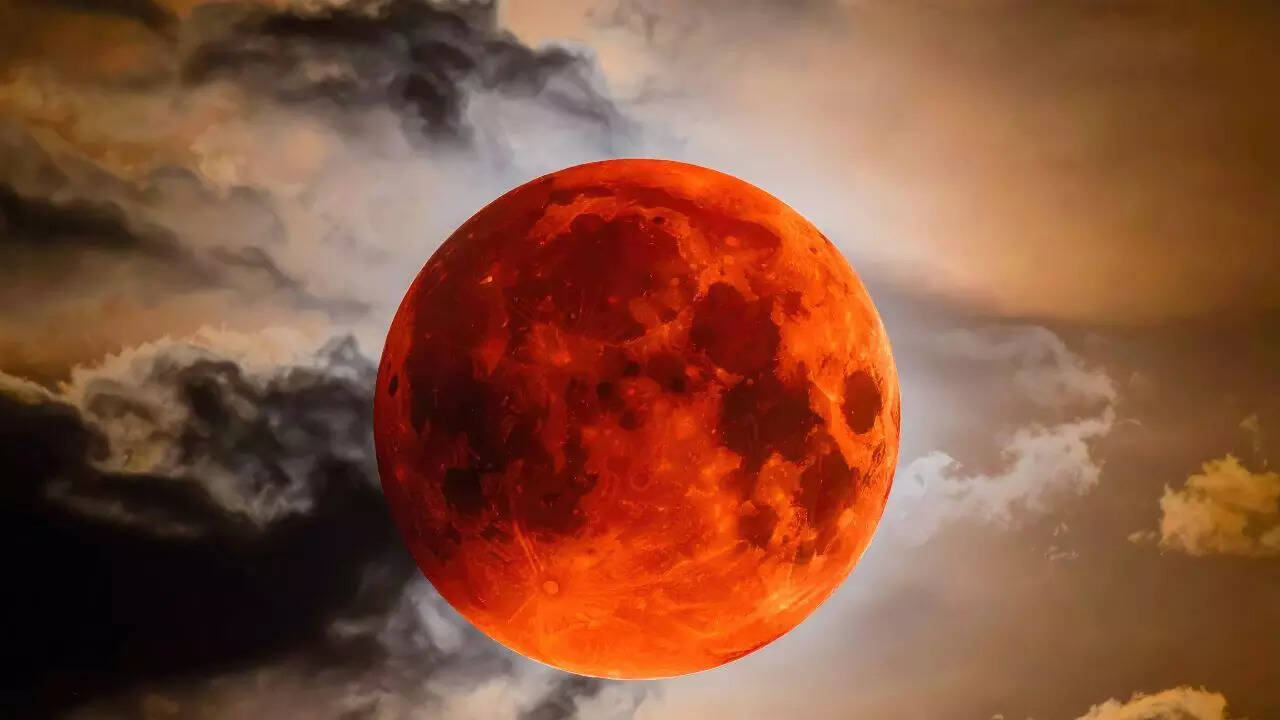
The headlines screaming about a "rare total lunar eclipse" or a "Blood Moon" coincident with Holi in 2026 are peddling a spectacular brand of scientific fiction. While the desire to link a major cultural festival with a rare celestial phenomenon makes for excellent clickbait, the mechanics of our solar system don't bend for the sake of a viral story. On March 3 and 4, 2026, there is indeed a lunar eclipse, but for the millions of people across India preparing their colors and sweets, the reality is far less crimson than advertised.
To understand why this "Blood Moon" narrative is falling apart, one has to look at the geometry of the Earth's shadow. A total lunar eclipse occurs when the Moon passes entirely through the Umbra, the darkest part of the Earth's shadow. This is what refracts sunlight—specifically the red end of the spectrum—onto the lunar surface, creating that eerie, rusty glow. However, the event coinciding with Holi 2026 is a penumbral lunar eclipse. In this scenario, the Moon only skims through the outer, fainter part of the Earth’s shadow.
For the casual observer standing in New Delhi or Mumbai, the visual change will be nearly imperceptible. The Moon will not turn blood-red. It will merely look slightly muted, as if a thin veil of smoke has been pulled across its face. If you aren't looking for it with a telescope or a high-end camera, you will likely miss it entirely.
The Mechanics of a Celestial Miss
The primary reason the "Blood Moon" label is being misused here lies in the confusion between the different types of lunar alignments. For a true total eclipse, the Earth, Sun, and Moon must align with surgical precision. This alignment, known as syzygy, happens at varying degrees of accuracy.
In a penumbral eclipse, the Sun's light is only partially blocked. Because the Penumbra is not a solid wall of darkness, enough light still reaches the lunar surface to maintain its brilliant white-grey appearance. Amateur astronomers often call these "pseudo-eclipses" because they lack the drama of a total or even a partial bite taken out of the Moon.
The 2026 event begins as the Moon enters the penumbra late on the night of Holi, but the timing is the second major hurdle for Indian viewers. The peak of the eclipse occurs while the Moon is either below the horizon for much of the subcontinent or during the early morning hours when the sky is already beginning to brighten.
Breaking Down the Visibility Gap
Most reports suggesting that Indians should "step out at dusk" are fundamentally flawed because they ignore the specific coordinates of the eclipse path. For the majority of India, the Moon will set before the eclipse reaches its maximum phase.
- Moonset Timing: In Western India, the Moon sets almost exactly as the penumbral phase begins.
- Atmospheric Interference: Even in regions where a sliver of the event is visible, the low altitude of the Moon near the horizon means you are looking through a thick layer of dust and pollution, which further washes out the subtle dimming of a penumbral shadow.
- The Holi Factor: The smoke from traditional bonfires (Holika Dahan) and the general haze of the festival season often create more of a visual "dimming" than the eclipse itself.
Why the Blood Moon Myth Persists
The term "Blood Moon" isn't a scientific designation. It’s a colloquialism that has been hijacked by social media algorithms to drive engagement. By labeling every lunar event as a "Blood Moon," publishers tap into a primal human fascination with celestial omens. This is particularly potent when paired with Holi, a festival that already celebrates the triumph of good over evil and marks a significant lunar milestone in the Hindu calendar.
There is a commercial incentive to keep the myth alive. Travel companies, "spiritual influencers," and even some news outlets benefit from the hype. They sell the idea of a once-in-a-lifetime spiritual alignment that simply isn't supported by the orbital data provided by agencies like NASA or the Indian Space Research Organisation (ISRO).
The Math of the Saros Cycle
Eclipses aren't random. They belong to families called Saros cycles, which last roughly 18 years, 11 days, and 8 hours. The eclipse on March 3-4, 2026, belongs to Saros 113. This specific series is currently in a phase where it only produces penumbral eclipses. It won't produce a total "Blood Moon" for centuries.
$$Total\ Cycles = 18\ years + 11.3\ days$$
When we track these cycles, we see that the last time India witnessed a truly dramatic total lunar eclipse on Holi was decades ago, and the next one isn't lurking just around the corner. To suggest otherwise is to ignore the predictable, clockwork nature of the heavens.
The Real Phenomenon Worth Watching
While the eclipse itself might be a dud for visual thrill-seekers, the astronomical context of Holi 2026 remains fascinating for those who know where to look. Instead of searching for a red moon that won't appear, observers should focus on the planetary alignments occurring in the same window.
During the week of Holi, Mars and Venus often sit in prominent positions in the pre-dawn sky. The contrast between the bright, steady light of the planets and the slightly dimmed Full Moon provides a better lesson in celestial mechanics than a hyped-up eclipse ever could.
Furthermore, the "Supermoon" effect—where the Moon appears slightly larger because it is closer to Earth in its elliptical orbit (perigee)—may coincide with this period. This doesn't turn the Moon red, but it does make the lunar craters and "seas" appear sharper through a pair of basic binoculars. This is the real story: a massive, bright, and highly detailed Full Moon overseeing the festival of colors, not a disappearing red orb.
The Impact on Rituals and Sutak
In Indian tradition, a lunar eclipse often triggers the "Sutak" period—a time when many temples close and certain activities are avoided. However, traditional Vedic astrology and modern astronomical consensus generally agree that a penumbral eclipse does not carry the same ritual weight as a total eclipse.
Because the Moon is never truly "grasped" by the dark shadow of the Earth, many priests and scholars argue that the Sutak does not apply. This is a crucial distinction for those planning their Holi celebrations. You do not need to hide indoors or discard food because of a shadow that is technically invisible to the naked eye. The fear-mongering surrounding the "Blood Moon" and its supposed ill effects is as scientifically hollow as the promise of its red color.
How to Actually View the Event
If you are determined to witness the 2026 penumbral eclipse, stop looking for red. Instead, look for a subtle "shading" on the southern limb of the Moon.
- Use Optics: A simple pair of 10x50 binoculars will show the slight drop in brightness that the human eye might miss.
- Photography: Use a DSLR with a long focal length (300mm or more). Take a photo before the eclipse starts and another at the predicted peak. Compare the exposure values; the second photo will require a slightly slower shutter speed to achieve the same brightness.
- High Ground: Since the Moon will be low on the horizon for India during the penumbral entry, you need an unobstructed view of the West-Southwest.
The obsession with "rare" events often blinds us to the consistent beauty of the sky we actually have. The 2026 Holi Moon will be a brilliant, silver lantern that lights up the night of the festival. It won't be blood-soaked, it won't be a "portal to another dimension," and it won't be the end of the world. It is simply a reminder that the universe operates on a scale that doesn't care about our holiday schedules or our need for a viral photo.
Check your telescope settings, ignore the sensationalist countdowns, and enjoy the moonlight for what it is: a steady, white glow over a landscape of color.