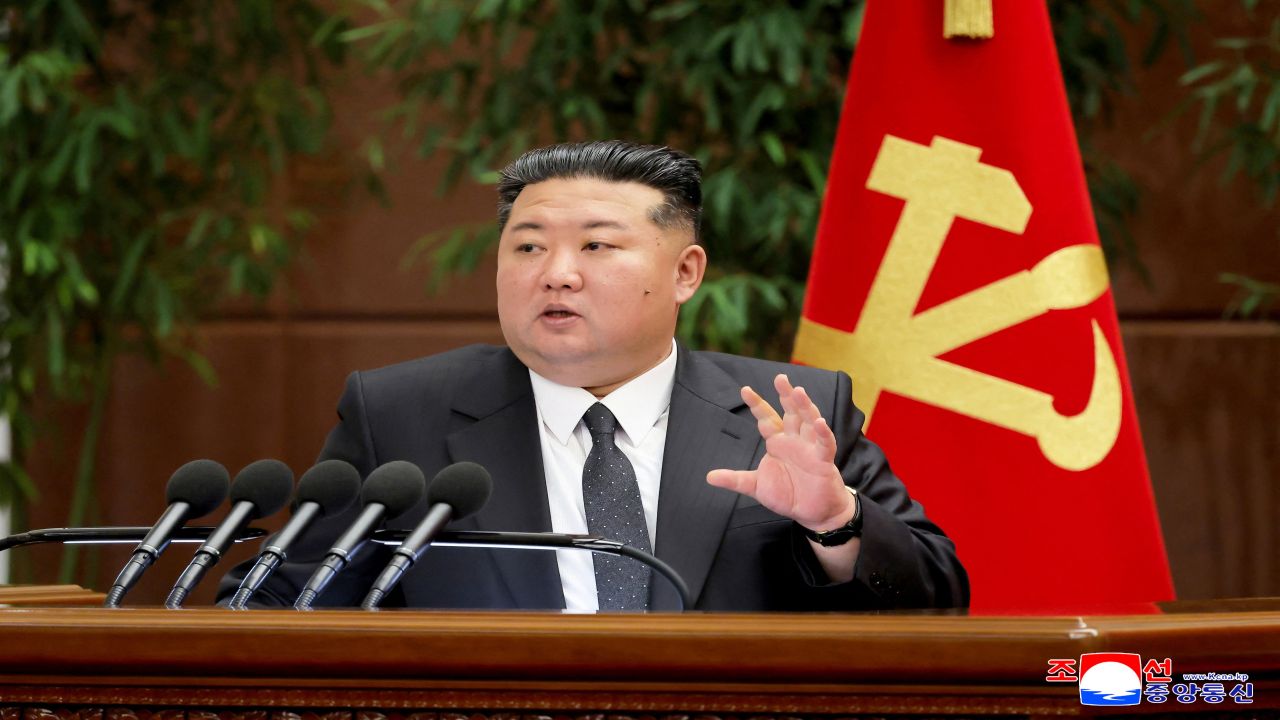
The recent re-election of Kim Jong Un as General Secretary of the Workers' Party of Korea during the Ninth Party Congress functions not as a standard political event, but as a strategic reaffirmation of a singular national directive: the normalization of North Korea as an irrevocable nuclear state. By utilizing a controlled assembly of party elites to codify this position, the regime has signaled a transition from the ambiguity of past brinkmanship to an operational doctrine of permanent nuclear deterrence.
The Mechanism of Consolidation
The re-election serves to validate the "Nuclear-First" cost function. In the internal logic of the Pyongyang leadership, the survival of the regime is inextricably linked to the possession of strategic parity with the United States. This is a binary system:
- The Deterrence Variable: The deployment of nuclear-capable delivery systems is treated as an insurance policy against external regime-change operations.
- The Legitimacy Variable: The state ideology, centered on the Kim family, requires the periodic renewal of the leader’s mandate to maintain internal cohesion.
By replacing aging military chiefs with a younger cadre, the regime is optimizing its internal structure for long-term endurance rather than immediate short-term tactical wins. This generational shift ensures that the bureaucracy governing the nuclear program is synchronized with the leader's long-term vision, effectively insulating the state against the fragmentation of power often observed in unstable autocratic transitions.
The Pivot to Hostile Autonomy
Recent reports indicate a significant evolution in inter-Korean policy. Where previous administrations operated under the theoretical possibility of eventual reunification, current state signaling suggests a formalization of a "two-state" reality. This shift reduces the strategic friction of maintaining the facade of eventual reconciliation.
The economic implications are equally critical. The leadership is doubling down on "self-reliance" (Juche), a response to the hardening of sanctions and the exhaustion of traditional diplomatic channels. This autarkic strategy relies on three pillars:
- Mass Mobilization: Utilizing the domestic labor force to offset the lack of capital investment.
- Asymmetric Trade: Leveraging arms transfers and strategic cooperation with external partners to bypass western financial isolation.
- Internal Resource Allocation: The deliberate prioritization of military-industrial output over consumer economic growth to ensure the sustainment of the nuclear shield.
The Nuclear Calculus
The regime has successfully moved beyond the phase of "demonstrative provocation"—where tests were used primarily as bargaining chips—into a phase of "operational integration." This involves the technical alignment of conventional forces with nuclear capability, creating a tiered military structure.
The danger for regional stability lies in the reduced threshold for escalation. When a state integrates nuclear and conventional command-and-control, the distinction between a localized skirmish and a nuclear incident blurs. This creates a strategic bottleneck for regional actors, particularly South Korea and Japan, who must now calculate the risk of nuclear escalation in every encounter, regardless of the scale.
The Strategic Outlook
The Ninth Party Congress confirms that the regime is not seeking a return to the negotiation table under existing terms. The focus is now on hardening the state against external pressures and projecting an image of an immovable strategic actor.
For outside observers, the immediate priority is to monitor for the formal codification of the "two-state" policy in the party charter. Such an action would indicate a permanent abandonment of the diplomatic status quo and force a recalibration of containment strategies across East Asia. The system is currently in a state of high-fidelity alignment; the regime is no longer optimizing for growth or international recognition but for the survival of the current governing architecture in a state of indefinite, armed isolation.
Strategic actors should prepare for a period of low diplomatic elasticity, where the regime’s behavior is driven not by external incentives, but by the rigid internal requirements of its own nuclear-focused survival model.