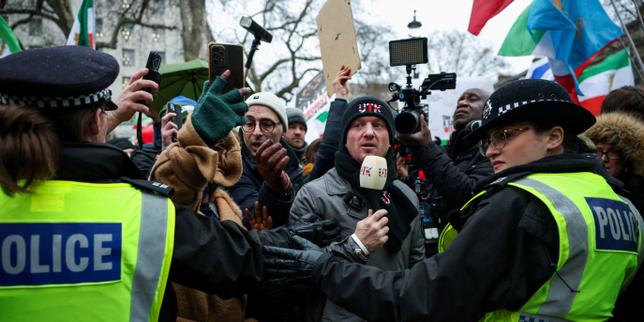
The Metropolitan Police are flooding the streets of central London again. Thousands of officers are pulling weekend overtime to manage yet another massive demonstration organized by Stephen Yaxley-Lennon, the convicted felon who operates under the pseudonym Tommy Robinson. While mainstream media coverage focuses almost exclusively on the immediate threat of street violence and the operational headache for Scotland Yard, this narrow view misses the real story. The escalating frequency of these rallies is not a spontaneous eruption of working-class anger. It is the direct result of a highly sophisticated, internationally funded digital apparatus designed to bypass traditional media gatekeepers and monetize civil unrest.
To understand why London is facing a prolonged summer of volatile street politics, one must look beyond the immediate flashpoints of counter-protests and police barricades. The true engine of this movement is a global financial pipeline and an algorithmically optimized outrage machine that converts physical confrontation into digital currency.
The Evolution of the Agitprop Business Model
Street agitation in the United Kingdom used to be a cash-strapped endeavor. In the days of the National Front and the early iterations of the English Defence League (EDL), movements relied on physical bucket collections, merchandise sales, and erratic donations from soccer hooligan factions.
That model is dead. Today, the operation led by Yaxley-Lennon functions like a modern, agile media tech startup, albeit one that trades in racial resentment and societal division.
When Yaxley-Lennon calls his supporters to Whitehall, the primary goal is not political lobbying. The British political establishment across both major parties has explicitly disavowed him. Instead, the street rally serves as a content generation engine.
Every scuffle with police, every fiery speech from atop a flatbed truck, and every encounter with counter-protesters is captured by a dedicated crew of videographers. This raw footage is instantly sliced into short, high-impact clips tailored for platforms like X, formerly Twitter, Telegram, and Rumble.
The financial mechanics are straightforward but devastatingly effective.
- Algorithmic Amplification: Re-platforming on major social networks has allowed Yaxley-Lennon to regain access to millions of viewers. High-engagement video content is prioritized by algorithms that reward outrage.
- Direct Monetization: Viewers are routed to crowdfunding platforms, alternative payment processors, and subscription-based video sites.
- Crypto Pipelines: When mainstream banks and payment gateways cut off service due to violations of terms of service, the operation pivots seamlessly to Bitcoin and other digital assets, rendering traditional financial sanctions ineffective.
This content does not just reach a domestic audience. A significant portion of the viewership and financial backing originates in North America and Australia, where conservative donors view the UK as a frontline battleground in a broader global culture war. The London marches are, in essence, a loss-leader for a highly lucrative international media business.
The Policing Dilemma and the Trap of Escalation
Scotland Yard finds itself caught in a structural trap that Yaxley-Lennon has spent more than a decade perfecting. The Public Order Act gives the police powers to impose strict conditions on the route, duration, and assembly points of marches to prevent serious public disorder. However, enforcing these restrictions requires a massive, visible show of force.
This creates a visual narrative that plays directly into the hands of extremist organizers.
When hundreds of riot officers form lines to contain a crowd, the imagery is immediately framed online as proof of a "two-tier policing" system. This narrative alleges that the British state treats right-wing working-class demonstrators with brutality while taking a soft approach to climate activists or pro-Palestinian marchers. It is a potent, easily digestible conspiracy theory that drives further radicalization and financial donations.
The financial cost to the taxpayer is staggering. A single major deployment of this scale costs the Metropolitan Police millions of pounds, draining resources from borough-level policing and community safety initiatives.
More importantly, the psychological toll on the city is cumulative. Each march turns the historic core of London into a militarized zone, normalizing the presence of overt ethno-nationalist rhetoric on public streets.
The Void in Working Class Representation
It is a mistake to dismiss every individual who attends these rallies as a committed ideological extremist. While the core leadership is undeniably rooted in far-right politics, the broader crowd includes people motivated by a profound sense of economic and cultural alienation.
Decades of deindustrialization, a chronic lack of affordable housing, and visible public service decay have left large segments of the British working class feeling entirely abandoned by Westminster.
When traditional political parties fail to offer a coherent analysis of these systemic failures, alternative voices fill the vacuum. Yaxley-Lennon offers a simplistic, binary worldview that blames complex macroeconomic shifts entirely on immigration and cultural change.
+-------------------------------------------------------------------+
|               The Extremist Outrage Feedback Loop                 |
+-------------------------------------------------------------------+
|                                                                   |
|   1. Systemic Economic/Social Decline                             |
|          │                                                        |
|          ▼                                                        |
|   2. Political Vacuum (Mainstream Parties Fail to Address Grievance)|
|          │                                                        |
|          ▼                                                        |
|   3. Far-Right Exploitation (Simplistic Anti-Immigrant Narrative) |
|          │                                                        |
|          ▼                                                        |
|   4. Street Manifestation & Provocation (London Marches)          |
|          │                                                        |
|          ▼                                                        |
|   5. Content Generation & Transnational Crowdfunding              |
|          │                                                        |
|          ▼                                                        |
|   6. Financial Influx Sustains the Core Apparatus                |
|          │                                                        |
|          └────────────────────────────────────────────────────────┘
The failure of center-left and center-right politicians to speak directly to these anxieties has effectively gifted the monopoly on working-class grievance to street agitators. Until the underlying structural issues of regional inequality and public underinvestment are addressed, the supply of disillusioned bodies for these marches will not dry up.
The Internationalization of Local Grievance
What is happening on the streets of London is no longer an isolated British phenomenon. The rhetoric, the imagery, and the tactical handbooks are thoroughly globalized.
Yaxley-Lennon's network maintains active communication with identity movements across continental Europe, particularly in France, Germany, and the Netherlands. They share digital strategies, legal defense tactics, and coordination methods.
The message has been standardized for an international audience. Local issues, such as the housing crisis in a specific London borough, are reframed as chapters in a global narrative of civilizational collapse. This high-stakes framing ensures that international donors remain engaged, viewing their financial contributions not as funding for a localized UK protest, but as an investment in a global resistance movement.
This transnational reality makes traditional domestic counter-extremism strategies largely obsolete. Banning an organization or restricting an individual's travel does little to stop the borderless flow of ideas and capital that sustains the movement.
Why Demplatforming Failed to Solve the Crisis
For years, the consensus among policymakers and civil society groups was that deplatforming—removing key agitators from mainstream social media—would permanently cripple their ability to organize.
For a time, it worked. When Yaxley-Lennon was removed from Twitter and Facebook several years ago, his audience shrank, and his ability to mobilize large crowds declined sharply.
However, the digital ecosystem has evolved. The emergence of alternative platforms that explicitly market themselves as free-speech havens has created an alternative infrastructure that is immune to Western regulatory pressure. Furthermore, the chaotic acquisition and shifting policy landscape of major mainstream platforms have allowed previously banned figures to return with their profiles enhanced by the narrative of martyrdom.
The return to mainstream platforms did not just restore the original audience; it introduced these figures to a younger generation that had missed the earlier iterations of the EDL. This new cohort is highly digitally literate, consuming political content through hyper-fast, short-form video formats that defy easy moderation or context-checking.
The Failure of the Counter-Protest Strategy
The standard response from the British left and anti-fascist organizations has been the immediate mobilization of counter-protests. The stated goal is to "take back the streets" and show that extremism is not welcome in the capital.
In reality, these counter-protests frequently serve as the final piece of the puzzle for the far-right content engine.
A march that takes place in a vacuum, with no opposition, is boring. It produces little usable video footage. It does not generate the dramatic tension required to drive viral social media engagement.
When anti-fascist groups show up, the potential for conflict increases exponentially. The resulting confrontations provide the exact high-octane imagery that Yaxley-Lennon’s media team needs to post online with captions screaming about attacks by political opponents.
The physical opposition on the street does not deter the marchers; it validates their sense of conflict and provides them with the adversarial dynamic necessary to keep the donations flowing. It is an symbiotic relationship where both sides use the presence of the other to justify their own existence and mobilization efforts.
Beyond the Police Lines
The British state cannot police its way out of this crisis. Every extra officer deployed to Whitehall is a temporary bandage on a deep, infected wound in the body politic. Relying solely on public order legislation and police containment strategies treats the symptom while allowing the underlying pathology to worsen.
The infrastructure supporting street extremism is resilient, wealthy, and technologically adaptable. It exploits genuine societal failures—economic neglect, institutional decay, and a collapse of faith in democratic processes—and turns them into a profitable digital commodity.
Disrupting this cycle requires an approach that goes after the financial incentives underpinning the entire operation. It demands rigorous enforcement of financial transparency laws regarding online donations, a coordinated international effort to track cross-border extremist funding, and a tech-regulatory framework that holds platforms accountable for the conscious monetization of hate.
More than anything, it requires a political class willing to step into the communities that have been abandoned to the far right, acknowledging their legitimate grievances without adopting the toxic, scapegoating rhetoric of the agitators. Until that vacuum is filled with genuine economic and social solutions, the digital outrage machine will continue to find plenty of fuel on the streets of London.