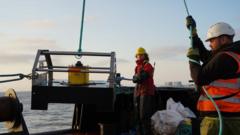
The proposed £50 million "fish disco" at the River Parrett represents an industrial-scale pivot from traditional chemical water treatment to biological filtration. This installation is not a recreational feature but a high-frequency acoustic and light-based exclusion system designed to solve a specific infrastructure bottleneck: the "Nutrient Neutrality" requirement currently stalling housing developments across the United Kingdom. By preventing fish from entering water intake pipes, the system allows for the massive extraction and treatment of nutrient-rich water, theoretically offsetting the phosphorus and nitrogen loads generated by new human settlements.
The Phosphorus Constraint on Fixed Asset Development
The core problem is not ecological sentimentality but a regulatory ceiling on phosphorus $(P)$ and nitrogen $(N)$ levels in protected waterways. Under current UK law, any new housing development must demonstrate "nutrient neutrality." If a proposed estate of 500 homes is expected to increase the phosphorus load of a local river by a specific mass, the developer must find a way to remove that exact mass elsewhere in the catchment area.
Standard mitigation strategies, such as creating new wetlands or fallowing formerly active farmland, are land-intensive. A single hectare of constructed wetland might only remove a few kilograms of phosphorus per year. In the Somerset Levels, where the River Parrett flows, the sheer scale of the housing backlog requires a mitigation strategy with a higher spatial efficiency. The "fish disco" functions as the gatekeeper for a high-volume filtration plant that can process water at a rate far exceeding the natural sequestration capacity of a swamp.
The Mechanics of Acoustic and Photic Exclusion
To understand why a £50 million investment is directed at lights and sound, one must analyze the failure points of traditional water intake. Standard mesh screens (physical barriers) often trap and kill fish—a process known as impingement—or allow smaller larvae to be sucked into the filtration machinery (entrainment). High mortality rates at these intakes trigger environmental vetos that shut down the entire project.
The system utilizes two primary behavioral deterrents to maintain high-flow intake without ecological collapse:
- Acoustic Deflection: Underwater sound projectors emit specific frequencies—typically between 20 Hz and 600 Hz—to exploit the "startle response" in cyprinids and other river fish. This creates a non-physical wall that repels species before they can reach the intake's suction zone.
- Strobe Light Desynchronization: High-intensity, high-frequency flashing lights are used as a secondary layer of deterrence. This is particularly effective during nocturnal or low-visibility periods when acoustic signals alone might be insufficient to guide fish away from the intake.
The effectiveness of these systems is not uniform across all species. While larger salmonids and percids respond well to acoustic signals, smaller, less-mobile species like eels require a different behavioral cue or a slower intake velocity to avoid entrainment.
Economic Leverage and the Farmland Paradox
A central claim of the River Parrett project is that it "saves farmland." This is a direct reference to the "fallowing" trade-off. To offset the nutrient load of a new housing development, developers are currently buying productive farmland and taking it out of commission to create "neutrality buffer zones." This process is economically inefficient for two reasons:
- Opportunity Cost: The loss of agricultural output reduces local food security and the revenue generated from the land.
- Sequestration Latency: It can take years for a newly fallowed field or a young wetland to reach peak phosphorus absorption capacity.
By contrast, a £50 million water treatment facility using biofiltration at a single point of intake allows for a localized, high-density phosphorus removal. This removes the need to fallow thousands of acres. The project represents a shift from "passive, land-intensive" mitigation to "active, capital-intensive" mitigation.
The Cost-Benefit Architecture
The £50 million price tag is often criticized, but it must be viewed through the lens of capital expenditure (CapEx) vs. operational expenditure (OpEx) for a housing developer. A developer facing a £200 million loss in delayed revenue due to nutrient neutrality laws can justify a £50 million contribution to a communal infrastructure project.
The primary risk factor is the "Scaling Bottleneck." While a single intake system on the River Parrett can handle a significant volume, the phosphorus removed from the water must be processed into a stable solid waste, which requires further chemical and biological handling. This creates a tertiary cost: the disposal and management of phosphorus-rich sludge.
The Technical Reality of Phosphorus Removal
The "fish disco" is only the intake mechanism. The actual "saving" of the water—and by extension, the farmland—happens in the filtration stages that follow. Phosphorus exists in river water in two primary forms:
- Particulate Phosphorus (PP): Adsorbed to sediment and organic matter, which can be removed through physical filtration and sedimentation.
- Soluble Reactive Phosphorus (SRP): The bioavailable fraction that triggers algal blooms. This requires more complex chemical precipitation (using ferric or aluminum salts) or biological uptake by microorganisms.
If the River Parrett facility relies on chemical dosing to remove phosphorus, it introduces a new variable: the "Siltation Factor." The Parrett is one of the siltiest rivers in the UK. Any intake system, regardless of its fish-deterrent capabilities, must manage a massive volume of suspended solids that will quickly clog membranes and saturate chemical reagents.
The success of the project hinges on its ability to separate the fish, the silt, and the soluble nutrients into three distinct streams without creating a new environmental hazard.
Limitations and Operational Friction
The most significant limitation of behavioral exclusion systems is their dependency on power and maintenance. Unlike a physical screen, an acoustic-strobe system fails immediately if power is cut or if the underwater projectors are fouled by biofilm and algae.
Furthermore, "Nutrient Neutrality" is a site-specific legal requirement. A treatment plant on the River Parrett can only offset developments within the same catchment area. This geographic rigidity prevents this technology from being a universal solution. Each river system has its own flow dynamics, species composition, and nutrient profile, necessitating a bespoke engineering solution for every major development hub.
The Strategic Recommendation for Local Authorities and Developers
The "fish disco" model should not be viewed as an isolated environmental project, but as a blueprint for "Collective Infrastructure Offsetting." Instead of individual developers attempting to solve nutrient neutrality on a plot-by-plot basis—which is land-intensive and legally precarious—a centralized, high-tech intake and treatment facility offers a scalable path forward.
For this model to be viable elsewhere, the following criteria must be met:
- Catchment-Scale Coordination: A unified body (e.g., a local council or a consortium of developers) must manage the facility to ensure the phosphorus credits are distributed fairly.
- Ecological Monitoring: Real-time data on fish repulsion rates must be made transparent to satisfy environmental regulators and prevent project shutdowns.
- Waste Valorization: The captured phosphorus should be processed into fertilizer to partially offset the facility's high OpEx and truly close the nutrient loop.
The shift toward behavioral exclusion and high-flow filtration marks the end of the "passive wetland" era and the beginning of a more clinical, engineering-led approach to landscape management.