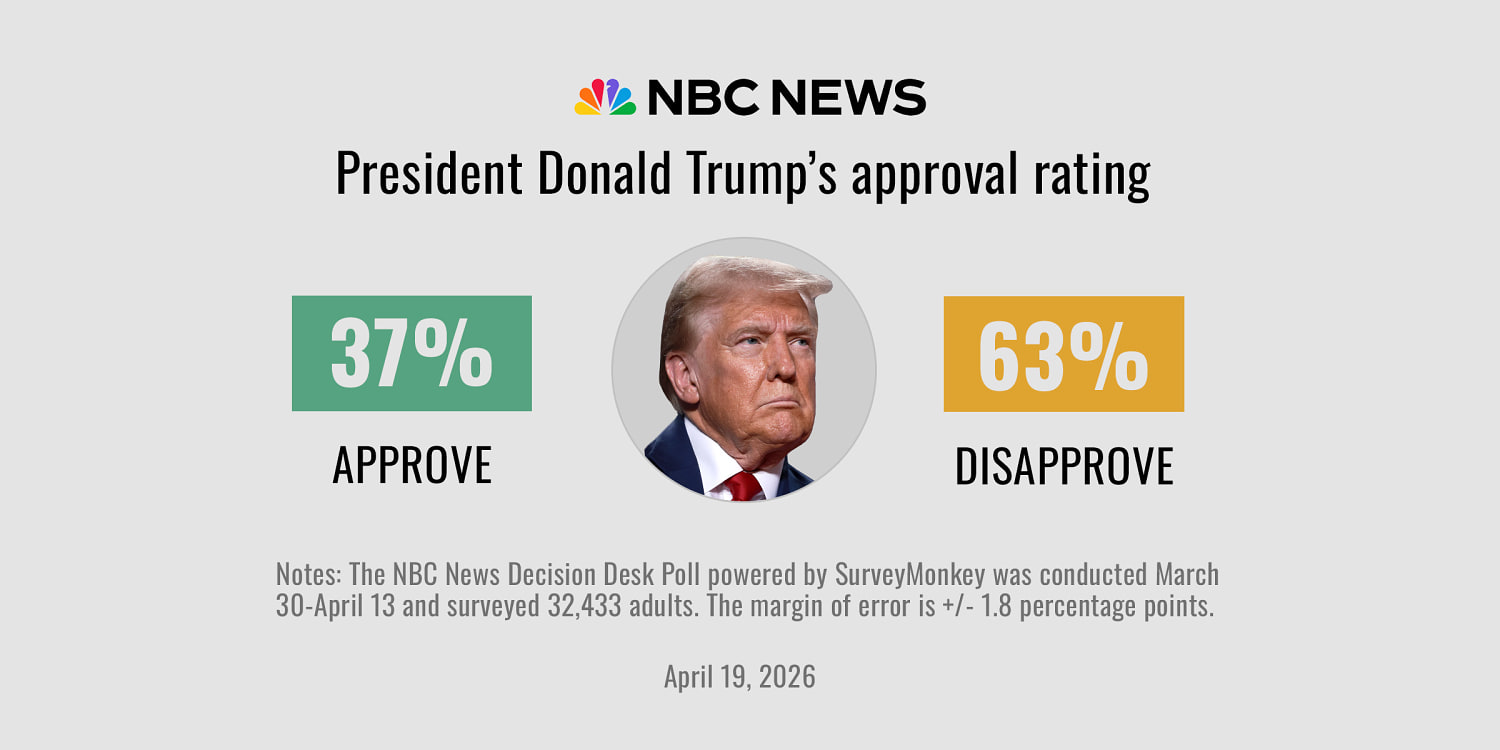
Polling is a lagging indicator for a leading personality. The media is currently salivating over a "second-term low" in approval ratings, linking it to economic anxiety and the friction with Iran. They are making the classic mistake of treating a disruptor like a traditional bureaucrat. In the world of conventional politics, a 38% approval rating is a death knell. In the era of high-frequency tribalism, it is a defensive fortification.
Most analysts view approval ratings through the lens of a popularity contest. They assume that if the number goes down, the power dissipates. They are wrong. For a populist incumbent, a low approval rating doesn't signal defeat; it signals the successful distillation of a core base. It is the political equivalent of a "short squeeze" in the markets. By alienating the middle, you solidify the fringes, and in a fractured electoral college, the fringes are where the math actually happens.
The Myth of the Rational Voter
The "sourness" on the economy cited by mainstream outlets ignores the fundamental shift in how Americans process financial data. We no longer look at GDP or unemployment as objective truths. We look at them through a filter of partisan identity. When a poll says "Americans are sour on the economy," what it’s actually saying is "The people who already disliked the President have found a new reason to justify it."
I’ve watched campaigns burn through hundreds of millions trying to "win back" the moderate center. It is a fool’s errand. The center has evaporated. When approval ratings hit a floor, they aren't falling into an abyss—they are hitting bedrock. This bedrock consists of voters who view a low approval rating in the New York Times as a badge of honor for their candidate. To them, if the "establishment" approved of him, he wouldn’t be doing his job.
Iran and the Theater of Controlled Chaos
The narrative that the conflict with Iran is "hurting" the President assumes that voters want stability. That is a 1990s assumption. We are living in a volatility-seeking era.
The average voter doesn't understand the nuances of the Strait of Hormuz or the intricacies of the JCPOA. They understand strength and they understand "The Other." Every time the media screams that we are on the brink of war, it reinforces the President’s brand as the only person willing to break the status quo.
The mistake the competition makes is thinking that fear leads to rejection. In reality, fear leads to a "rally 'round the flag" effect, even if people claim to be unhappy about it in a phone survey. They might tell a pollster they are worried about war, but when they enter the voting booth, they vote for the person they think will be the biggest bully on the playground.
Why Economic Pessimism is a Paper Tiger
If you look at the raw data, the "economic souring" is often a reflection of inflation sentiment rather than actual purchasing power.
- The Lag Effect: People feel the price of eggs before they feel the growth in their 401(k).
- The Media Echo Chamber: If every headline screams "Recession is Coming," consumer sentiment drops even if spending remains high.
- The Comparative Gap: Voters don't compare the President to an idealized version of the economy; they compare him to the alternative candidate.
History is littered with leaders who had "underwhelming" approval ratings and still steamrolled their way to victory because their opposition failed to provide a cohesive counter-narrative. Approval is a measure of affection. Voting is a measure of utility. You don't have to like the mechanic to want him to fix the car—especially if you think the other guy is going to drive it off a cliff.
The Efficiency of Being Hated
There is a tactical advantage to being unpopular with the "right" people. Every time a celebrity or a high-profile pundit decries the current administration, it acts as a free advertisement for the base.
The competitor’s article focuses on the "low." I focus on the "floor." If 40% of the country will support you even if you start a war and the economy wobbles, you are only 4 to 5 points away from a winning coalition in the key swing states. That is not a position of weakness. That is a position of extreme leverage.
Stop asking if the President is popular. Start asking if his detractors are organized. A low approval rating often breeds complacency in the opposition. They see the 38% and think the work is done. They think the "moral arc of the universe" will handle the rest. Meanwhile, the incumbent is operating with a leaner, meaner, and more focused message that ignores the 60% who will never vote for him anyway.
The Math of the Electoral College vs. The Luxury of Popularity
In a direct democracy, these poll numbers would be a disaster. But we don't live in a direct democracy. We live in a system where 50,000 voters in three specific states matter more than 5 million voters in California.
- Popularity is a national metric that feels good at cocktail parties.
- Intensity is a localized metric that wins elections.
A "low approval rating" usually means you’ve lost the people who live in ZIP codes that don't decide the presidency. If you lose 10% of the vote in Brooklyn, your approval rating drops, but your path to 270 remains exactly the same.
The Hidden Data in the Disapproval
When you dig into the "disapproval" numbers, you find a surprising amount of "soft disapproval." These are people who don't like the tweets, don't like the rhetoric, but love their tax bracket or the judicial appointments. When push comes to shove, these "sour" Americans will hold their noses and pull the lever for the incumbent because they fear the alternative more than they dislike the current reality.
The competitor’s article is a snapshot of a mood. My analysis is a map of the machinery. Moods change with the wind. The machinery of polarization is permanent.
The War Sentiment Paradox
Regarding Iran, the contrarian view is that the American public actually has a very high tolerance for foreign intervention as long as it is framed as "America First." The opposition tries to frame it as "senseless war." The administration frames it as "stopping the bad guys." In a soundbite-driven culture, "stopping the bad guys" wins every single time, regardless of what the approval ratings say in January.
Imagine a scenario where the administration executes a targeted strike that successfully de-escalates a situation through a show of force. The same people currently "sour" on the war will be the first to claim they supported the President's "decisiveness." Public opinion is not a rock; it is a liquid. It takes the shape of the container it’s poured into. Right now, the President is the one holding the container.
The Danger of Trusting the Consensus
I've seen analysts get this wrong for decades. They look at the "Topline" and ignore the "Trendline." They see a dip and call it a crash. They don't realize that in a hyper-polarized environment, the "swing voter" is largely a myth. Most people have already decided. The polling "dip" is often just a temporary expression of frustration from the base that hasn't seen enough "winning" lately. Once the campaign cycle heats up and the "Us vs. Them" narrative is re-established, those numbers will snap back like a rubber band.
The consensus says the President is in trouble. I say the President is exactly where he wants to be: underestimated, under fire, and ignored by the "experts" who have been wrong about him since 2016.
If you are waiting for a low approval rating to translate into a political exit, you are playing a game that no longer exists. We are in the era of the "Unpopular Victor." The sooner you accept that popularity is a vanity metric, the sooner you can understand the actual mechanics of modern power.
Polls measure how people feel today. Results measure how people act when they are forced to choose between two flawed options. Never mistake a bad mood for a lost cause.
Stop reading the headlines. Start looking at the floor. The floor is holding, and that is the only thing that matters.