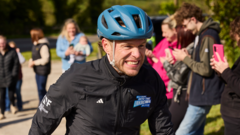
Mass-participation charity campaigns frequently rely on elite athletic spectacles to capture public attention, but the operational model shifts dramatically when a single public figure anchors the entire activation. The 400-kilometer endurance challenge undertaken by presenter and musician Olly Murs for the 20th anniversary of Soccer Aid for UNICEF represents a highly calculated stress test of both human physiology and multi-platform media orchestration. Moving from Manchester’s Old Trafford to the London Stadium over five consecutive days via running, cycling, and rowing requires more than sentimental motivation. It demands an analysis of structural physical stress, asymmetric information barriers, and the mechanics of financial leverage through matched funding.
Media coverage of such events typically favors emotional narratives, describing the participant as being "pushed to the limit" without defining where those limits lie or how they are managed. To understand the true efficacy of a 400-kilometer cross-country transit, the endeavor must be deconstructed into its component operational realities.
The Tri-Factor Physical Cost Function
Endurance events that combine distinct modalities present a compounding metabolic and structural tax on the human body. Unlike a single-discipline marathon, a multi-modal transit introduces distinct biomechanical stressors that actively interfere with muscle recovery.
- The Eccentric Deceleration Bottleneck (Running): The initial stage of the transit through the Peak District involved crossing the Kinder Scout plateau and descending via Jacob’s Ladder. Descending steep gradients forces the quadriceps to contract eccentrically to decelerate body mass against gravity. This eccentric action maximizes micro-tears in the muscle fibers, leading to severe delayed onset muscle soreness (DOMS) and localized joint inflammation. For a participant with a history of knee surgeries, this creates an immediate structural deficit on day one.
- Concentric Non-Impact Flushing (Cycling): The cycling segments, such as the transit through Hope Valley to the Tissington Trail, utilize concentric muscle actions. While less damaging to muscle tissue, the prolonged hip and knee flexion restricts blood flow if postural alignment is imperfect, compounding the fatigue generated by prior running stages.
- Upper-Body Kinetic Isolation (Rowing): Transitioning to a solo row along the Trent and Mersey Canal shifts the primary metabolic demand to the latissimus dorsi, biceps, and core stabilizers. Because the cardiovascular system is already taxed from lower-body exertion, the efficiency of oxygen delivery to these upper-body muscle groups drops, accelerating the accumulation of blood lactate and causing localized muscular failure.
The core vulnerability in this five-day sequence is the absence of systemic reset time. The metabolic waste produced during the running phase remains trapped in the lower extremities during the cycling phase, altering the participant's gait and increasing the probability of acute compensatory injuries.
Asymmetric Information and Adaptive Psychology
The defining operational constraint of the "Into The Unknown" campaign is the deliberate withholding of geographic information. The route details are revealed to the participant live on Heart Breakfast moments before deployment each morning. This asymmetric information structure eliminates the ability to engage in anticipatory pacing.
In a standard endurance event, an athlete manages energy expenditure via a pre-calculated pacing strategy tied to specific distance markers and elevation profiles. Removing this data forces the brain into an defensive preservation state. The central governor theory of fatigue posits that the brain modulates pacing to protect the body from catastrophic failure based on expected duration and intensity. When the duration, incline, and terrain are unknown, the central governor increases the subjective perception of effort early in the exercise bout.
This psychological bottleneck was apparent when the participant faced the immediate vertical gain of the Peak District on day one, followed by a 100-kilometer multi-modal trajectory on day two. The cognitive load of navigating unforeseen physical boundaries accelerates mental exhaustion, creating a direct conflict between physical capability and the psychological willingness to continue.
The Economic Architecture of Matched Funding
The operational risk of the physical challenge is counterbalanced by a highly efficient capital-raising mechanism. The financial structure relies on a 1:1 matched funding agreement with the Children’s Investment Fund Foundation (CIFF), cap-restricted at £6 million. This framework transforms individual micro-donations into a high-leverage corporate fundraising instrument.
[Individual Micro-Donations] ---> [Soccer Aid Platform]
                                          │
                                          ▼
                             [CIFF Matched Funding Scheme] (1:1 Leverage)
                                          │
                                          ▼
                            [Total Capital Impact: Max £12M]
                                          │
                        ┌─────────────────┴─────────────────┐
                        ▼                                   ▼
             [Child Nutrition Fund]              [Localized Hub Infrastructure]
This economic model exploits a behavioral economic principle known as the framing effect. Donors are more likely to commit capital when they perceive their individual purchasing power is instantly doubled. A standard £15 donation, which provides capital for child vaccinations, is structurally transformed into a £30 financial injection.
The allocation of these funds is targeted at systemic interventions rather than temporary relief. The capital is routed directly into the Child Nutrition Fund to combat severe acute malnutrition and iron-deficiency anemia, alongside supporting localized infrastructure like the Pipera Primo Hub in Bucharest. By funding integrated centers that provide education, therapeutic music, and sport sessions for displaced children, the capital is converted from liquid donations into long-term institutional support.
Media Synchronization and Audience Retention
A physical challenge of this scale requires a synchronized broadcasting architecture to maintain the public engagement necessary to drive donations. The campaign utilizes a dual-layered media strategy that pairs real-time audio updates with high-production visual broadcasts.
Daily live updates on Heart Breakfast and ITV’s This Morning establish a real-time narrative arc, treating the physical toll on the participant as a live variable. This is backed by a structured digital tracking campaign on social platforms to maintain engagement between broadcast windows. The entire operational sequence concludes with a scheduled primetime documentary on ITV1 and ITVX.
This multi-platform distribution ensures that the audience is captured at various stages of the consumption funnel: casual listeners are introduced via morning radio, highly engaged viewers track the midday progress online, and mass-market donors are converted during the television broadcast.
Strategic Recommendation for Subsequent Executions
To optimize future single-celebrity endurance campaigns, organizers must move away from arbitrary distance metrics and implement an analytical framework that maximizes both physical safety and donation velocity.
- Biometric Pacing Transparency: Future campaigns should integrate live biometric data streaming (heart rate variability, blood glucose tracking, and core body temperature) directly into the public broadcast overlay. This replaces vague descriptions of fatigue with undeniable empirical evidence of physical strain, increasing audience empathy and accelerating real-time donation spikes.
- Dynamic Milestone Incentives: The matched funding mechanics should be coupled with specific geographic or physical milestones. For instance, breaking the funding down so that hitting a specific donation threshold unlocks a route advantage (e.g., a flatter segment or a brief recovery window) aligns the audience's financial behavior directly with the participant's physical well-being.
- Post-Event Capital Tracking: To secure long-term donor retention for future Soccer Aid iterations, the post-challenge media strategy must transition into a rigorous impact report. Documenting exactly how the capital raised during the five-day transit stabilizes the target infrastructure provides the transparency required to sustain institutional donor trust over multi-year cycles.