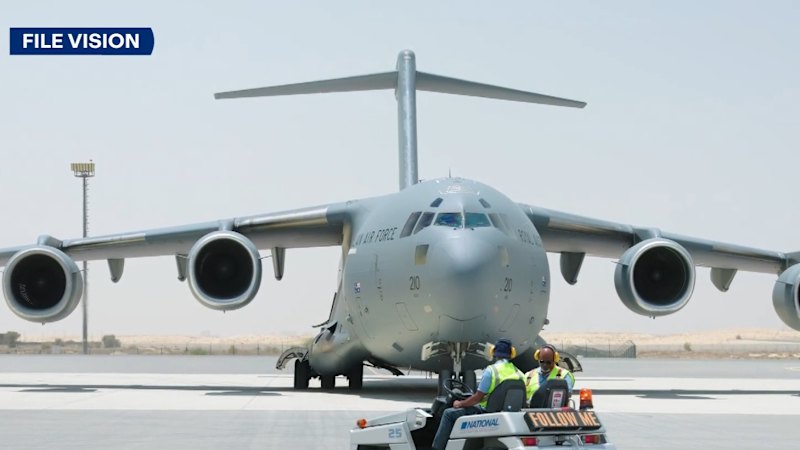
Australia’s Middle East headquarters at Al Minhad Air Base was struck by Iranian drone and missile fire over the weekend, a direct consequence of the escalating US-Israeli war on Iran. While Defence Minister Richard Marles has confirmed that all Australian personnel are safe and accounted for, the strike marks a significant breach of the "safe harbor" status Australia has enjoyed in the United Arab Emirates for over two decades. The base, located 24 kilometers south of Dubai, has transitioned from a sleepy logistics hub into a front-line target in a conflict that is rapidly outstripping Canberra's ability to protect its assets and its citizens.
The official line from Canberra is one of stoic reassurance. Marles and Prime Minister Anthony Albanese have spent the last 48 hours emphasizing that the roughly 80 to 100 personnel on-site emerged uninjured. However, the reality on the ground paints a far more chaotic picture. Eyewitnesses in nearby residential districts like Damac Hills 2 reported large explosions and the sound of aerial interceptions, while unverified reports suggest a medical facility within the base was among the structures hit. This was not a symbolic gesture by Tehran; it was a calibrated strike on a facility that serves as the primary nerve center for Australian operations across twelve different regional missions.
The end of the UAE sanctuary
For twenty years, Al Minhad was the "open secret" of Australian defense policy. It was the jumping-off point for the wars in Iraq and Afghanistan, a place where troops could decompress and logistics could be managed far from the reach of insurgent rockets. That sanctuary has evaporated. By backing the recent US-Israeli strikes that killed Iranian Supreme Leader Ayatollah Ali Khamenei, Australia has effectively signed away the neutral protection previously afforded by its presence on Emirati soil.
The Iranian retaliation has not been limited to military targets. The strikes that hit Al Minhad were part of a broader wave that damaged Dubai International Airport and the Jebel Ali seaport. This is a deliberate message to the UAE and its Western partners: hosting foreign militaries now carries a price that commercial interests may no longer be willing to pay.
Stranded in the crossfire
While the government focuses on the safety of its uniformed personnel, a much larger crisis is brewing for the 115,000 Australian nationals currently scattered across the Middle East. Airspace closures have effectively turned the region into a gilded cage. Foreign Minister Penny Wong has upgraded travel advice to "Do Not Travel" for much of the Gulf, but for those already there, the advice to "leave now" is a bitter irony when the runways at the world's busiest international hub are scarred by missile impacts.
The logistical nightmare of a mass repatriation is currently beyond the ADF’s immediate capacity. With Al Minhad itself under threat, the very base intended to facilitate "regional crisis response" is now preoccupied with its own defense. The government has activated its crisis center, but "monitoring the situation" is a cold comfort to families trapped in Riyadh, Jeddah, or Dubai as the "four-week" war timeline promised by some US officials looks increasingly optimistic.
A breakdown of the rules-based order
The political fallout in Canberra is becoming as volatile as the region itself. The strike on Al Minhad has emboldened critics who argue that Australia's support for "pre-emptive" strikes lacks a clear legal foundation or an exit strategy. Figures like Andrew Hastie have been blunt, suggesting that the "rules-based order" often cited by diplomats is a fantasy in a world where "apex opportunists" dictate the pace of conflict.
Australia finds itself in a precarious position. It is too deeply embedded in the US military architecture to pull back, yet it lacks the independent regional influence to shield its people from the blowback. Al Minhad was designed to be a hub for projecting power; it is now a magnet for retaliation.
The "safe and accounted for" status of our troops is a relief, but it is not a strategy. As long as Australian forces remain anchored to a base that Iran now considers a legitimate target, the question is not if the next strike will occur, but whether the luck of the first night will hold. The government must now decide if the strategic value of Al Minhad is worth the risk of a mass-casualty event that would leave Canberra with no good options and 115,000 citizens with no way home.
Ask yourself what the plan is when the next drone doesn't miss the barracks.