Stop mourning the trade deficit.
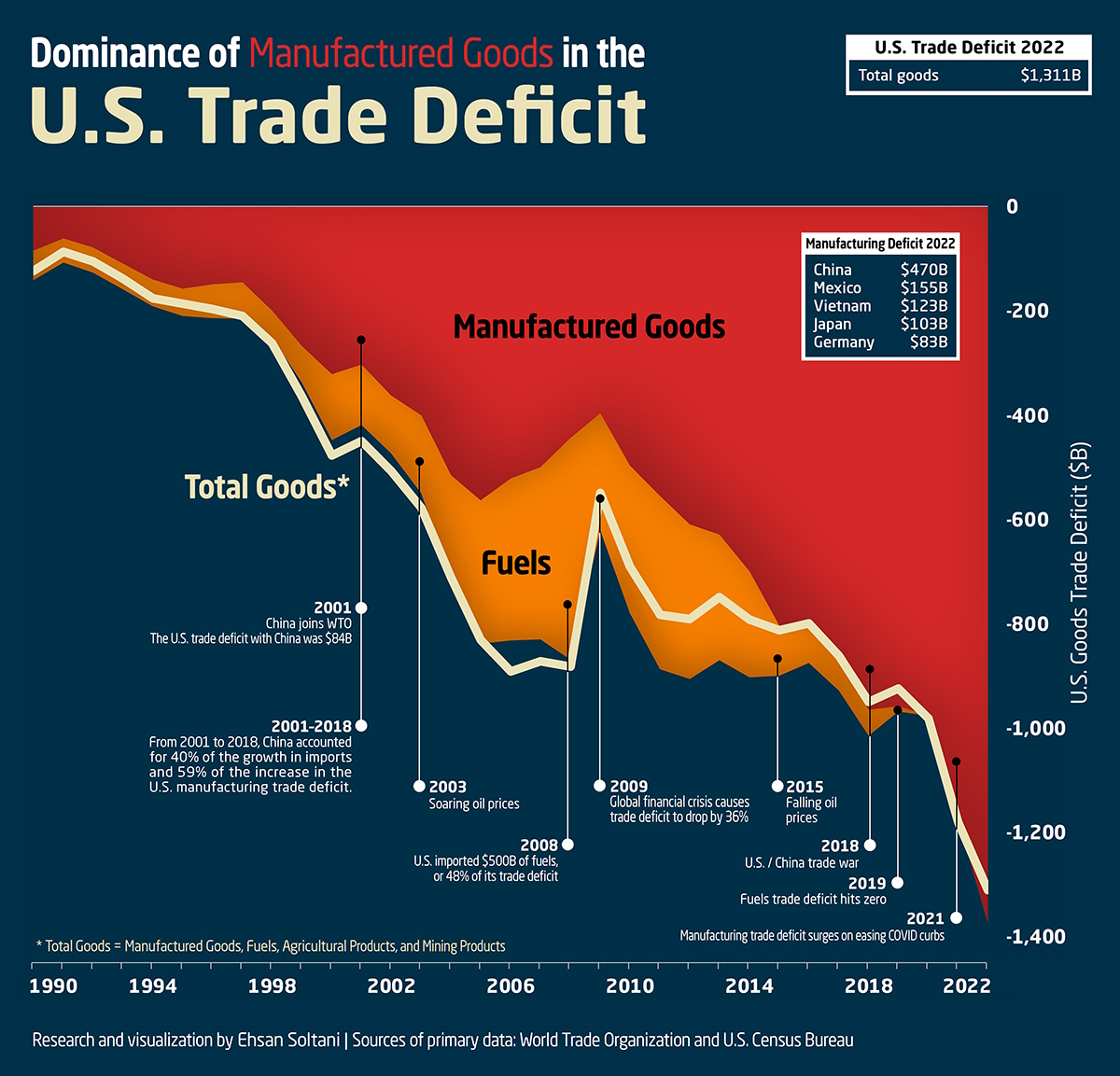
The media is currently obsessing over the 2025 year-end data showing a $901 billion gap. They point to the "stubborn" numbers as proof that tariffs failed, that the American consumer is being crushed, and that the manufacturing renaissance is a myth. They are looking at the scoreboard from the wrong side of the field.
A massive trade deficit is not a debt. It is a receipt.
If I walk into a grocery store and exchange twenty dollars for a bag of ribeyes, I have a "trade deficit" with the grocer of twenty dollars. I am "down" twenty bucks; he is "up." Yet, nobody calls me a loser in that transaction. I have the steaks. I have the value. The grocer is left holding paper that loses value at the rate of inflation while I am nourished.
The United States is the grocery customer of the world, and we are dining on the finest cuts while the rest of the globe competes to see who can give us the most stuff for the lowest price. The $901 billion deficit represents a massive inflow of real-world wealth—goods, machinery, and electronics—in exchange for digital entries and paper currency that we control.
The Tariff Fallacy: Why Persistence is the Point
The lazy consensus claims tariffs "didn't work" because the deficit didn't vanish. This assumes the goal of a tariff is to stop trade. It isn't. The goal of a strategic tariff is to alter the composition of trade and tax the entry of hostile capital.
We saw the deficit hold steady because the American economy is fundamentally more resilient than its peers. While Europe stagnated and China’s property bubble continued its slow-motion implosion throughout 2025, the U.S. consumer kept buying. We have the highest disposable income on the planet. Of course we imported $901 billion more than we exported. We are the only ones with the money to spend.
Critics argue that "consumers pay the tariffs." This is a half-truth that ignores the elasticity of the supply chain. I have sat in boardrooms where shipping routes were redrawn in weeks to avoid a 25% duty. When the U.S. levies a tariff on Chinese steel or electronics, the Chinese exporter often eats a portion of that cost to maintain market share, or the assembly moves to Vietnam or Mexico.
The deficit stayed high because we shifted where we buy, not that we buy. This is a strategic win, not a statistical loss. We are successfully de-risking from single-point-of-failure adversaries while maintaining the standard of living that a high-import economy provides.
The Accounting Error That Governs Global Policy
Most pundits treat the Balance of Trade as the only metric that matters. They ignore the Capital Account.
For every dollar that leaves the U.S. to buy a foreign car, that dollar has to go somewhere. It doesn't disappear into a black hole. It eventually flows back into the United States in the form of investment. Foreigners use those dollars to buy U.S. Treasuries, American real estate, and shares in Silicon Valley tech firms.
The $901 billion "deficit" is actually a $901 billion "Investment Surplus."
The world is literally sending us their tangible goods in exchange for the privilege of investing in our future. They are betting on our growth. If the trade deficit were to hit zero tomorrow, it would mean the world had stopped trusting the dollar and stopped wanting to own a piece of the American economy. That is the day you should actually start worrying.
The Manufacturing Myth: We Don't Need to Make Toasters
There is a romanticized, 1950s-era obsession with "bringing back the jobs." People see the trade deficit and assume it means we’ve lost our edge.
We haven't. We’ve evolved.
The U.S. has moved up the value chain. We export high-margin intellectual property, software, aerospace technology, and financial services. We import low-margin plastic junk and basic assembly.
Why would we want to compete with a factory in Southeast Asia to produce $10 toasters? The "deficit" in those sectors allows us to focus our labor force on $100,000-a-year jobs in biotech and AI infrastructure. When you see a $901 billion deficit, you are seeing a country that has successfully outsourced the drudgery of the industrial age so it can dominate the information age.
- Logic Check: If a company spends more on R&D and equipment than it makes in sales for a year, we call that "scaling."
- The Reality: The U.S. is a scaling superpower. We are importing the physical tools of the future while the rest of the world remains addicted to the old model of export-led growth.
The Hidden Tax on Exporting Nations
Being an "export-led" economy, like Germany or China, is actually a trap. These nations are dependent on the American consumer. They are vulnerable to our policy shifts.
By maintaining a large trade deficit, the U.S. gains immense geopolitical leverage. We are the "Buyer of Last Resort." If we stop buying, their economies collapse. If they stop selling to us, we just buy from someone else. The deficit is not a sign of weakness; it is the tether that keeps the global economy tied to Washington’s interests.
When the 2025 data shows the deficit "barely budging," it proves that despite the noise, the U.S. remains the indispensable engine of global wealth. Our "debt" is their "income." And since we print the currency the debt is denominated in, we hold the ultimate high ground.
Stop Asking "How Do We Fix the Deficit?"
The premise of the question is flawed. You don't "fix" a sign of strength.
If you want to understand the health of the U.S. economy, stop looking at the trade balance and start looking at the Real Gross Domestic Output and Fixed Private Investment. In 2025, those numbers showed a domestic economy that is cannibalizing the rest of the world's growth.
Instead of trying to force a trade surplus—which would require a massive, painful contraction of American living standards—we should be doubling down on the things that make our "deficit" possible:
- Energy Independence: Use our natural gas and oil to lower domestic production costs so we can export energy, the one commodity everyone needs.
- Regulatory Arbitrage: Make it easier to build here than anywhere else. Tariffs only work if they are paired with a domestic environment that doesn't strangle the companies trying to move back.
- Currency Dominance: Ensure the dollar remains the world's reserve currency so we can continue to trade "paper" for "stuff."
The Brutal Truth
The pundits crying about the $901 billion figure want you to feel like America is a failing business. They want you to think we are being "cheated" by our trading partners.
The truth is the opposite. We are the ones winning the deal. We get the iPhones, the cars, the clothes, and the toys. They get the dollars, which they immediately give back to us so they can buy our debt and our stocks.
It is the greatest lopsided trade in the history of civilization.
If the trade deficit "barely budged" in 2025 despite massive geopolitical shifts and aggressive tariff regimes, it’s not because the policy failed. It’s because the American appetite for wealth and the world’s appetite for American stability are both bottomless.
Stop looking for a "balance." In the real world, someone is always the lead, and someone is always following. As long as that deficit remains high, we are the ones in the lead.
The trade deficit is not a hole in our pockets; it is a mountain of goods we didn't have to break our backs to build. Stop trying to close the gap and start enjoying the view from the top.
If you want to see a country in real trouble, look for the one with a massive trade surplus and a starving population. We’ll keep the deficit, thanks.